In short:
- Alan Milburn’s final report on young people and work proposes a Ready-for-Work Standard for schools, and AI skills training available to every young person.
- In the Youth Voice Census the report draws on, 69 per cent of young people had used AI tools, but only 19 per cent believed technological change would create more opportunities. We think schools are where that gap can start to close.
- Keep humans in the loop: data that flags a pupil at risk should start a conversation with a trusted adult, and a new standard should not become another dashboard for teachers.
On 17 November 2026 Alan Milburn, the former health secretary, published the final report of his review of young people and work, From a Welfare State to a Working State: A new settlement for the next generation. Nearly one million young people, one in eight, are not in education, employment or training (NEET). The report’s ambition is to cut that rate to around 5 per cent by 2036. Its own modelling of the proposed reforms reaches about 6.8 per cent; Milburn argues that faster growth and new momentum in the youth labour market should close the gap.1
The government responded the same day with a promise of a funded college place for every young person who wants one, and said plans for curriculum reform and vocational GCSEs would follow in the coming weeks. Lucy Powell, the education secretary, called the findings “a clarion call for change”.2
Milburn calls for a “whole-system reset” in five areas: a new bargain with employers to create more first jobs, apprenticeships and work experience; schools, colleges and universities judged partly on whether young people move on to further learning and work; an NHS that intervenes earlier; a new benefits system for under-25s, with statutory entitlements to opportunity and support, and loss of benefit, which he says should be rare, for those who persistently refuse to engage; and a permanent Youth Opportunity Service in every part of England.1
This piece looks at what the report asks of schools, and at what being ready for work means when AI is changing both the first jobs young people apply for and how they apply.
What the review asks of schools
- From 2028, a Ready-for-Work Standard that assesses each pupil and adds up to a published school ready-for-work rate, including the gaps for pupils on free school meals and with SEND. The government would give that rate “parity of esteem” with the headline measures Ofsted already uses, and destination measures would judge schools more on where pupils go and whether they stay there.
- A statutory key stage 3 check in writing, numeracy and oracy, with schools given discretion over around 10 per cent of curriculum time.
- A lighter GCSE exam load.
- Work experience as a statutory duty: employer projects, visits, talks and tasters in key stage 3, and a real workplace placement in key stage 4, spread across the year rather than at exam time.
- Risk of NEET Indicator (RONI) tools, which use school data to spot pupils at risk of becoming NEET, made mandatory in primary and secondary schools.1
These are recommendations, not yet policy. The government’s first response was about colleges, with curriculum plans to follow.2 The Department for Education said it would consider the recommendations carefully, “including how a ready for work standard fits alongside those wider reforms”. Nor is it yet clear exactly how schools would be assessed against the standard.3
Unions and sector leaders have urged caution. Paul Whiteman, general secretary of the National Association of Head Teachers (NAHT), said schools “do not need another accountability measure judged by Ofsted”. Pepe Di’Iasio, general secretary of the Association of School and College Leaders (ASCL), backed the focus on work experience and careers guidance but criticised “the usual mishmash of targets, tests, and new accountability measures”, and asked for a realistic plan and the funding to deliver it. Leora Cruddas, chief executive of the Confederation of School Trusts, warned against “over-emphasising the role of schools and underplaying the economic arguments”. Daniel Kebede, general secretary of the National Education Union (NEU), welcomed fewer GCSE exams and the key stage 3 flexibility, but warned that “whatever Milburn intends, statutory tests become high stakes”.3
Milburn accepts that schools “often feel overwhelmed”, but argues the changes are justified.1 “We don’t want to overload schools, and we don’t want to overload teachers,” he told a press conference, “but teachers themselves are saying something is not working, and something has got to change.”3 We return to workload below.
What the report says about AI
The report is measured about AI. It says the technology “will create opportunities as well as disruption”, that it would be wrong to blame AI for the recent rise in young people dropping out of work and learning, and that nobody can know precisely what its impact will be over the next decade. But it warns of “a real risk that young people bear a disproportionate share” if the entry-level tasks through which earlier generations learned how to work disappear faster than new routes are created. The question, it says, is “whether the next generation gets a fair share of the opportunities it creates”. Elsewhere it puts the danger more starkly: young people “face the risk of an AI-led employment meltdown”.1
The first rung is already thinner. Entry-level vacancies have fallen by 49 per cent over the past decade, and entry-level recruitment has become more formal, more remote and increasingly automated. A young person can now be rejected, the report notes, for doing badly in a recorded interview or for not knowing how an automated application system works. It describes a “rejection economy” of application after application, often without feedback, and rejections that arrive months later.1 Writing before the final report, Josh Hillman, director of education at the Nuffield Foundation, warned that AI “may intensify” the problem, through automated screening and AI-mediated recorded interviews.4
The report’s answers include:
- training in AI skills available to every young person, building on initiatives such as the AI Skills Hub;
- a small AI Youth Observatory to track where entry-level tasks and jobs are shrinking or changing;
- employers testing automated recruitment for barriers unrelated to the job, and businesses that receive significant public support showing how they will keep building their future workforce as technology changes;
- assessment that keeps supervised exams while finding rigorous ways to test judgement, problem-solving and practical competence.1
The report also draws on the Youth Voice Census, in which 69 per cent of young people had used AI or machine-learning tools, but 55 per cent said technological change made them uncertain about the future and only 19 per cent believed it would create more opportunities. “This is not a generation turning its back on change,” the report says. What many cannot see clearly “is where they will fit in the labour market it is helping to create”.1
A young person can be punctual, literate and numerate and still be filtered out by a system they have never been told exists. For schools, the report’s answer is adaptability: the education changes it proposes focus on “growing adaptability and agility skills that are the best insurance policy against the harmful impact of change”. It asks the government to make AI skills training available to every young person, but does not say what that training should cover or who should deliver it, only that it should reach the places at greatest risk of disruption.1 In our view, work-readiness should include knowing how these systems work and how to reach the human behind them, and school is the one place almost every young person passes through.
Mark Martin MBE of the UKBT Institute, an AI Awareness Day partner, welcomed the review but questioned whether qualifications alone are enough:
“This is a welcome review. As teachers, we have many ways to get young people into good tech jobs: mock interviews, hackathons, changes to courses, developing software and creating the qualifications industry needs. But the glaring missing issue is that many young people who do have AI and tech qualifications are still finding it hard to break into the industry. What chance does a young person who is NEET have?”
Mark Martin MBE, UKBT Institute
That is why the employer side of the report’s “give and get” bargain matters as much as the school side. It asks employers to create more first jobs, apprenticeships and work experience, and larger employers to give feedback even when they cannot offer a job.1
What we mean by AI literacy
The report says every young person should leave school knowing how to find an opportunity, complete an application and approach an interview.1 It does not define “AI skills”, so here is our view.
AI literacy starts with knowing what AI is: being able to define and explain the main kinds of AI and how they relate, from machine learning and deep learning to natural language processing and generative AI. Ultimately, an AI-literate young person can say: I understand when AI is being used in society, how it affects my daily life, and how I use it to navigate the world around me responsibly.
Being ready for an AI workplace builds on that. It means using AI as an assistant to improve productivity and keep developing, and using generative AI responsibly, in line with the digital literacy skills young people already need.
We think AI is more likely to displace work than replace it. Self-service checkouts are a familiar example: fewer staff on the tills, and new roles building, programming and maintaining the machines. The risk the report identifies is that old entry-level tasks disappear faster than new routes into work are created.1 Young people need to understand that shift, not only use the tools.
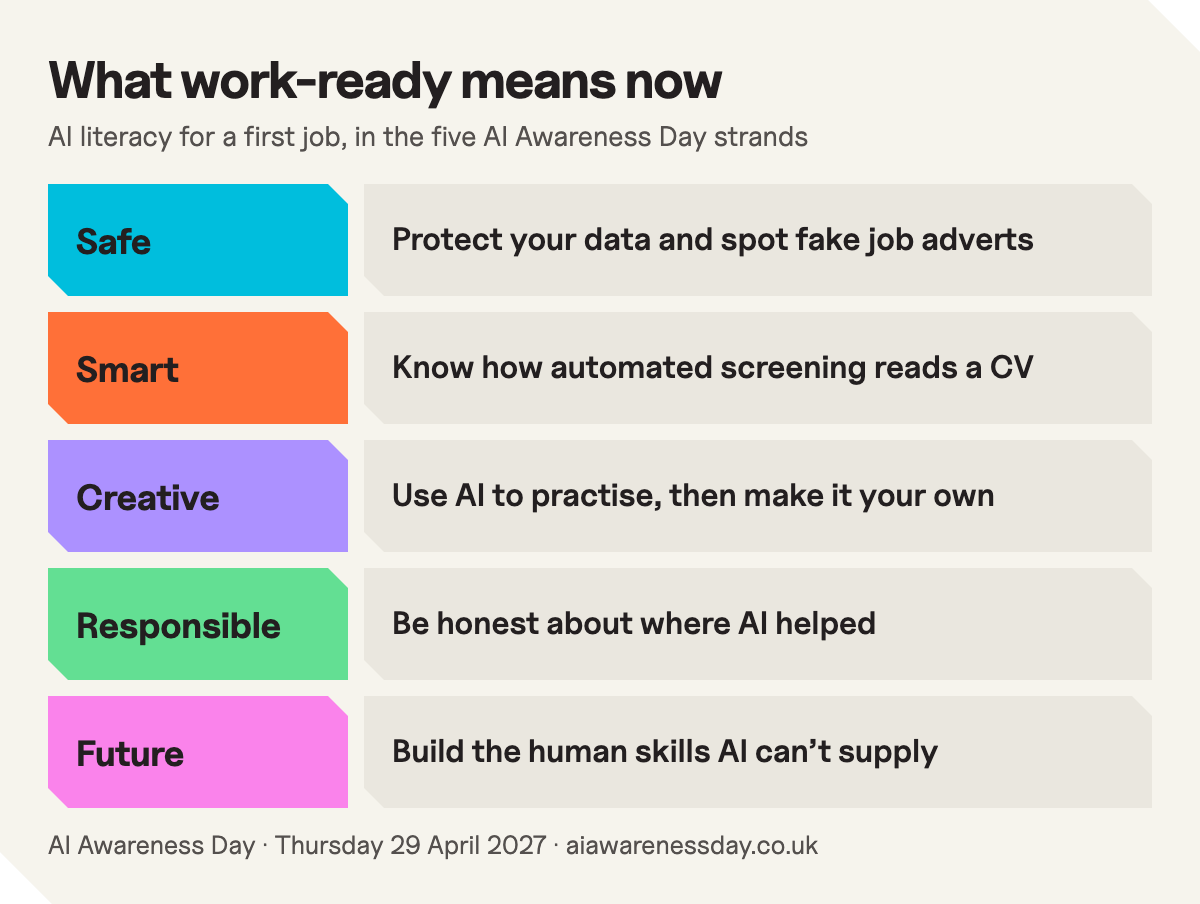
The five AI Awareness Day strands turn this into something schools can teach. The Smart strand, for example, answers the report’s warning that young people are rejected for not knowing how automated application systems work.
Oracy: the part no tool can do for you
The review backs a statutory key stage 3 check in oracy, alongside writing and numeracy. It says this “should be a diagnostic check, not a new high-stakes exam”, there to find pupils who need extra support while there is still time to give it.1 Kebede of the NEU doubts a statutory test can stay that way.3 The proposal comes a month after Powell announced that oracy will have equal status with reading and writing, as a new strand of the English curriculum.5 The government aims to publish the final revised curriculum by spring 2027, for first teaching from September 2028.6 We set out what that means for schools in oracy and AI Awareness Day.
Powell made the link with AI herself, arguing that “with AI on the rise” the curriculum needs to “go harder” on human skills such as oracy.5 When a tool can draft a CV or a cover letter in seconds, what sets a young person apart is the ability to explain their thinking, answer a follow-up question and listen properly to someone else. That is the part of an interview no tool can do for them.
AI is itself a good subject for that practice: current, contested and close to pupils’ lives. Each of our free five-minute lesson starters poses one big question with a UK fact to react to. In November 2026 we began piloting the National Debate Network with primary, secondary and post-16 students, and the youth-led National AI Conversation opens on 1 January 2027.
Keep humans in the loop
Under the review’s proposals, every school would use RONI tools to spot pupils at risk of becoming NEET. These bring together information schools already hold, such as attendance, attainment, care experience, SEND and exclusions. The report is clear that “data only matters if it leads to human contact”, and that every pupil at material risk of disengagement “should be known by an adult in the school”.1
School leaders are wary. Whiteman said earlier identification would help, but schools “would be concerned if this was used primarily as a monitoring, reporting or accountability tool”. Cruddas was cautious about requiring primary schools to use such tools.3
A data flag can help a busy school notice a pupil sooner. It cannot build the trust that keeps that pupil coming to school. Our 2027 theme, Keep Humans in the Loop, suggests three questions for any RONI tool:
- Does every flag lead to a conversation with a named adult?
- Do pupils and families know what data is used, and why?
- Can a teacher who knows the pupil overrule a wrong flag?
The report applies a similar principle to the predictive tools it proposes for health services, which “should support professional judgement, not make decisions” about a young person’s treatment or participation. It wants AI-enabled careers tools to free more face-to-face time for the young people who need it most.1 The same should hold for employers: if AI does the first sift of job applications, a young person should still be able to reach a person, and get the feedback the report asks employers to give.
Use the new space, without adding workload
If 10 per cent of the key stage 3 timetable sits outside the national curriculum, many subjects will bid for it. The report’s own examples include debating, enterprise and employer-led projects.1 AI literacy does not need its own slot or a new course: it fits inside careers education, work experience preparation and oracy practice. AI Awareness Day, on Thursday 29 April 2027, asks schools to run one activity, and our free resources are organised by the five strands.
Leaders are right to worry that a Ready-for-Work Standard could become one more thing to measure. Before adding any new metric, it is worth asking:
- Does it change what happens for a pupil, or only what gets reported?
- Who checks the data, and can a pupil or family question it?
- What will teachers stop doing to make time for it?
Try it this week:
- Ask a key stage 3 class: “If a computer reads your job application first, what should it look for, and what might it miss?”
- Have pupils answer “Tell me about a time you acted on feedback” out loud, then compare their answer with an AI-written one you prepared in advance. Which sounds like a real person, and why?
- In a staff meeting, ask how your school would explain a RONI flag to a pupil and their family.
Milburn is right that getting ready for work cannot wait until a young person leaves school. The test for schools will be whether pupils learn how AI is changing work, and whether every pupil the data flags has a conversation with an adult who knows them.
Sources
1. Alan Milburn, From a Welfare State to a Working State: a new settlement for the next generation, final report of the review of young people and work, GOV.UK, 17 November 2026.
2. Department for Education, Government fires starting gun on new settlement for young people, GOV.UK, 17 November 2026.
3. Esmé Kenney, Milburn review: Leaders ‘cautious’ about school ‘work-readiness’ standard, Schools Week, 17 November 2026.
4. Josh Hillman, Can AI help young people into education and work?, FE News, 13 November 2026.
5. Lucy Powell, Education Secretary speech at CST Conference 2026, GOV.UK, 15 October 2026.
6. Department for Education, New curriculum to give young people the skills for life and work, GOV.UK, 4 November 2025.
Cover photo: Alan Milburn’s official portrait, UK Government, used under the Open Government Licence v3.0.