At St Paul’s Girls’ School in west London, a teacher who asks AI to grade an essay breaks school policy. At Ecclesall Primary in Sheffield, a teacher may use AI to help mark work and write reports. At the University of Salford, staff may use it to support marking, provided students are told.
Pupils face the mirror image. A sixth-former who openly declares AI help on coursework earns no marks for the parts AI produced. A Salford undergraduate may use AI by default in most assessments, and may refuse it without penalty. Same country, same technology, opposite rules.
Four years after ChatGPT reached classrooms, the rules are being written institution by institution. In a National Education Union survey in February 2026, only half of teachers said their school had an AI policy at all, the Education Policy Institute reported.
We read the published AI policies of ten institutions, issued between January 2025 and September 2026: three independent schools, a state secondary, a primary school, a primary trust, a further education college and three universities. They agree on principles and split on practice: who may use AI, which tools, for what, and on whose judgement. They swing from full embrace to near-ban, so what a learner may do depends on the building. The sharpest split runs underneath, in who wrote them.
Every one of those policies has three jobs: to protect pupils, under safeguarding and data-protection law; to protect the integrity of assessment, under exam-board rules; and to tell staff where AI can save them time. Which job leads shapes everything else in the document.
What the law actually requires
Less than many staff assume. No law in England requires a standalone AI policy. The Department for Education (DfE) publishes guidance on generative AI, and Keeping Children Safe in Education (KCSIE), the statutory safeguarding guidance, expects schools and colleges to address AI-related online risks.
The firmest rules come from the exam system. GCSEs and A-levels are regulated by Ofqual, the exams regulator, and assessed under rules the awarding bodies set together through the Joint Council for Qualifications (JCQ). JCQ requires every exam centre to keep a malpractice policy that covers AI, reviewed annually. Pupils who pass off AI work as their own in coursework commit malpractice, with sanctions up to disqualification.
That threat is being sharpened. In November 2026, Ofqual’s chief regulator, Sir Ian Bauckham, told ITV News that such pupils face “life-altering” penalties. Ofqual recorded 100 proven cases of AI plagiarism in summer 2025, up from 85 a year earlier. They made up 75 per cent of all student plagiarism cases, against 55 per cent the year before. Bauckham’s own answer is human: teachers’ knowledge of their pupils, he said, is the “most powerful weapon” against AI cheating.
The same rules lean the other way for teachers. Under JCQ guidance reported in November 2026, each centre may decide whether staff use AI to help mark coursework, provided AI is never the sole marker.
Below formal qualifications, homework misuse falls to each school’s own behaviour or academic-integrity policy. Universities sit outside JCQ altogether.
Who decided schools need one?
No minister did. The first firm demand came from the exam boards. In March 2023, months after ChatGPT’s launch, JCQ published its first guidance on AI in assessments, the origin of the malpractice-policy rule, according to the exam board Eduqas. That rule binds the secondaries and colleges that run exams. It says nothing to primaries.
The government’s own position is guidance. The DfE’s leadership toolkit, published in June 2025, tells schools to update their “child protection, including online safety policies and behaviour policies” for the risks of AI: existing policies, not a new one. The same toolkit warns against publishing a policy that an AI tool has written from another school’s text.
Ofsted says it does not inspect AI as a stand-alone subject and does not expect schools to use AI at all, though inspectors may look at a school’s policy on pupils’ use. KCSIE’s filtering and monitoring duties have covered generative AI since September 2025.
The gap between “update your policies” and “write an AI policy” has been filled by a market. A search for school AI policy templates returns at least eight providers offering “DfE-aligned” versions, most of them free and most attached to paid products or training. The widely shared finding that only 2 per cent of schools have an AI strategy came from a report by Accenture, a consultancy, with Teach First. Public bodies publish free templates too, among them SWGfL and Derbyshire’s Education Data Hub.
None of that makes the risks imaginary. Plagiarism, deepfakes and attacks on school systems are real, and the JCQ and KCSIE duties bind. But the duty is to make existing rules cover AI. The standalone policy is a choice, and much of the pressure to make it comes from providers with products or training to sell. For a head, the first move is to check the behaviour, online-safety and safeguarding policies already in place, not to commission a new document.
Schools, trusts and colleges have taken on that choice anyway, largely without help from the law. An Act of Parliament would set the same rules in every classroom, enforced by law. Guidance instead leaves each institution to write its own, from the same DfE documents, with whatever time, expertise and templates it can find. The result is that the rules a pupil lives by depend on which building they walk into.
What they all agree on
The ten are named because their policies are public documents anyone can check, and they are examples of different approaches, not a league table. Almost every formal policy among them:
- bars staff and students from entering personal data into unapproved AI tools;
- ties AI use to existing safeguarding duties (in schools and colleges, under KCSIE);
- requires AI use in submitted work to be acknowledged;
- holds the human user responsible for checking AI output for accuracy and bias;
- protects pupils’ and students’ own work from being used to train AI models without consent;
- commits to frequent review, annually or sooner, because the technology moves faster than the paperwork.
Several policies also concede that evidence on what AI does for learning is still thin, and most present AI as a tool to support teachers rather than replace their judgement.
Two ends of a pendulum
On practice, the ten sit between two poles. At one end, AI is a learning aid to be taught and used, the next step in education technology. Salford makes it the default in assessment, JAGS writes it into the curriculum and Ecclesall lets ten-year-olds experiment. At the other end, the hatches are battened down. Glenthorne provides pupils with no AI at all, and New York City, the largest school system in the US, has paused student-facing generative AI for children up to eighth grade for the 2026–27 school year, the Queens Chronicle reported. Most of the ten sit somewhere in between.
Closing the door is not simple technophobia. Glenthorne says its staff must first “understand and are competent in the use of AI” and that Microsoft has not authorised Copilot for pupils. Ecclesall’s own risk register names the fear behind most restrictions: “over-reliance on AI by pupils or staff”, and with it “reduced critical thinking skills”. Every AI-written essay is also one more piece of work a teacher must read, question and check.
Teachers have been here before. When Wikipedia arrived, pupils pasted in whole entries, sometimes with whatever else the search had turned up, down to a local plumber’s advert. Schools did not, in the end, ban the internet. They taught pupils to cite, check and summarise, and changed the homework. The question now is whether AI follows the same path.
The independent schools: values, judgement and two voices
James Allen’s Girls’ School (JAGS) in Dulwich has no standalone AI policy among the more than 40 documents on its policies page. In December 2025 it launched a Senior School AI Charter and Curriculum, a statement of shared values drawn up after surveying parents and consulting students and staff, the school said in a newsletter.
Its binding text sits in the Teaching and Learning Policy, reviewed in June 2026. It commits the curriculum “at all levels” to digital literacy and the “responsible and judicious” use of AI, taught by all staff. It sets no tool rules, no AI-specific malpractice clause and no limits on staff use.
The word choice is itself a finding. A charter declares shared commitments; a policy sets enforceable rules. In its readable public text, JAGS treats AI as something to be taught, not policed. The charter is published as a flipbook whose text could not be extracted, so its specific commitments are not analysed here.
St Paul’s Girls’ School shows the other independent-school model. Its 15-page Generative AI Use Policy, approved in January 2026, lets pupils use AI only when a teacher explicitly permits it for a given task.
Its hardest lines fall on staff. Teachers may not use AI to assess pupil work: doing so, the policy says, undermines the trust at the heart of teaching. Nor may they use it to write UCAS and US university references, or let it inform decisions on admissions, discipline, safeguarding or predicted grades.
Its register of seven tools is tiered by age and data type. Pupils aged 13 and over may use Copilot, Gemini and NotebookLM; ChatGPT, Perplexity, Claude and Google’s AI Mode in Search are approved for staff only. Parents’ consent for approved tools is covered by the school’s parent contract. Pupils who use AI complete a reflection sheet, which teachers grade from Needs Improvement to Exemplary.
The school rejects AI detectors as unreliable and biased against pupils with English as an additional language (EAL). Behind it sit a director of innovation, a digital strategy group that vets every tool, and a pupil AI-literacy programme.
JAGS’s Dulwich neighbour Alleyn’s School speaks in two registers. Its policy, now in its third issue, deals in acceptable-use agreements, JCQ malpractice rules and “AI plagiarism detectors or our academic judgment” to spot misuse.
Its LinkedIn post for the inaugural AI Awareness Day on 4 June 2026 promoted AiQ, “Alleyn’s Intelligence Quotient”, as a blend of “digital, ethical and empathetic skills” that gives pupils “agency”. The policy speaks the language of compliance; the post, the language of a prospectus.
The head, Jane Lunnon, went further. She described a leadership away day examining how AI touches every area of the school, from teaching and assessment to “commercial” and “marketing”. AI, she argued, needs the same “pervasive lens” as safeguarding. None of the formal policies in this sample treats AI as a question of a school’s business model.
The state secondary: staff first, pupils later
Glenthorne High School, a state secondary in Sutton, south London, shares its AI policy with two primary schools in its trust. The version published online is dated June 2025 and promised a first review by February 2026.
It is the clearest case of containment in the sample. The trust “has decided to initially only use AI tools with staff”. Providing AI tools to pupils at school “is not permitted”, and any pupil pilot would not begin until at least September 2026, with parental consent.
The policy does not pretend pupils are untouched. It acknowledges that many already use AI at home and that the school “cannot prevent this”. It does not endorse such use, but requires pupils to disclose how and how far AI was used. Teachers will adapt homework so AI cannot complete it.
Staff get one AI assistant, Microsoft 365 Copilot, plus OtterAI for meeting notes. ChatGPT, the policy says, “does not meet the educational standards the Trust requires”. On detectors, it advises staff to “consider using AI detection software if reliable”.
Its roadmap is operational. The school planned to pilot an AI agent for admissions communications with prospective parents, and AI minute-taking for meetings. St Paul’s bans staff from using AI to transcribe meetings at all, on privacy grounds.
The policy also shows how quietly AI has entered routine work. Its reading list carries links tagged “utm_source=chatgpt.com” and citation fragments such as “gov.uk+15gov.uk+15”, the marks left when references are gathered from a ChatGPT answer. That is no failing of the author, and many staff now research this way. It is a reason for policies to say how staff may use AI for research and drafting, not only which tools are approved.
The primaries: one built for compliance, one for the classroom
The two primary policies in the sample could hardly be further apart. Learning Academies Trust, a primary trust, ratified its policy on 19 November 2025. It was drafted by the trust’s IT operations manager and approved by its finance and operations committee, and its focus follows: data protection, procurement and access.
That focus has strengths. Staff must complete all four DfE “Using AI in Education Settings” video modules and read the policy before requesting access to any AI tool. The board of trustees signs off every new tool or use, on the data protection officer’s advice.
The register is short: Microsoft 365 Copilot, TeachMate, KeyGPT, Oak’s AI lesson planner and Google’s AI Overview, each labelled “open” or “closed”. Staff are told to look for Copilot’s green shield to confirm they are inside the protected enterprise version.
Pupils are not banned outright. They may use approved tools for research or lessons about AI, but not in assessments or to write homework presented as their own. Breaches go through each school’s behaviour policy. The declared purpose is staff workload, and approved Copilot uses run from drafting policies to data analysis. AI literacy sits in computing and PSHE (personal, social and health education) lessons.
Ecclesall Primary School in Sheffield is the counterpoint. Its policy, adopted in September 2026, gives its school business manager the lead on AI overall, but hands teaching and learning to its deputy headteacher, and those sections read like a teacher’s brief rather than an IT procedure.
It opens the door that St Paul’s keeps shut. Staff may use AI to help with marking and feedback, to write pupil reports and to spot patterns in attainment, provided they review every output and remain “the key decision-makers”. Teachers may also help pupils get AI feedback on their own writing, “replicating peer assessment processes”, with staff monitoring what the tool says.
Pupils may “explore and experiment” with age-appropriate AI projects in class, and AI education is to be built into the curriculum: what AI can do, where it fails and how to judge whether its answers are accurate. Pupils are taught never to enter personal data, including their own email addresses, and staff warn them about people who use AI to pretend to be someone else. Staff are told to be “cautious” about AI detectors. A list of approved tools is promised in the policy’s action plan but not published with it.
The text began elsewhere. The policy says it “has been adopted and amended” from a template by the Education Data Hub, a schools service run by Derbyshire County Council. That is a sensible starting point for a small school. But the policy also promises to follow JCQ rules on AI in assessments, written for GCSE and A-level coursework. The rules that bind a primary’s key stage 2 tests (SATs) come from the Standards and Testing Agency, and the policy does not mention them.
The FE college: an employment document as much as an education one
Leicester College issued the third version of its AI Usage Policy in January 2025, covering staff, students and apprentices. It was originated by the college’s director of governance and policy.
One clause would appear in no school policy here. Staff will use AI to reduce workload “while maintaining appropriate staffing levels”, the language of a workforce settlement. AI efficiency, in other words, is not meant to be banked as job cuts.
Like St Paul’s, the college restricts staff: no AI for writing student reports, for feedback on summative work, or for information, advice and guidance. Unlike St Paul’s, it uses Turnitin, alongside staff expertise, to look for AI misuse.
Student rules are framed by the awarding bodies, and a college deals with many of them, vocational as well as academic. Students may not use AI to create or modify assessed work, misuse “is likely to be considered malpractice”, and every submission carries an authenticity declaration.
The approved-tool list sits off-policy on an internal IT hub, “amended regularly”. The policy’s own list of tools students must acknowledge still includes Google Bard, renamed Gemini in early 2024, a reminder of how quickly these documents date.
The universities: from enforcement to entitlement
The University of Salford’s policy, version 2.0, took effect in May 2026 after consultation with staff unions and the students’ union. It reverses the logic of every school document here.
Assessment guidance “should take the default position to allow” appropriate AI use. A lecturer who wants a ban must justify it in writing and redesign the task so AI users gain no advantage.
Students gain a right that schools do not offer: to refuse AI “without detriment”. Where premium tools are essential, the university must provide them. Staff may use approved AI to support marking if they tell students, and AI detectors are barred from misconduct cases.
Rules are delegated to departments, which must write guidance graded by level of study, from awareness in the first year to strategic use at master’s level. The vocabulary is developmental: agency, critical digital literacies, justification.
Other universities show the range. Oxford became the first UK university to give every student and member of staff free ChatGPT Edu, from 2025–26, after a year-long pilot with about 750 participants. Its answer to unequal access is to buy the tool for everyone.
York leans towards enforcement. It names Google Gemini as its preferred tool, but has added “false authorship” to its misconduct offences, and warns that work showing “indicators of generative AI” may be judged false authorship.
Same laws, opposite rules
The grid compares six of the ten on five questions. JAGS, Alleyn’s, Oxford and York are left out: their public documents answer too few of the questions.
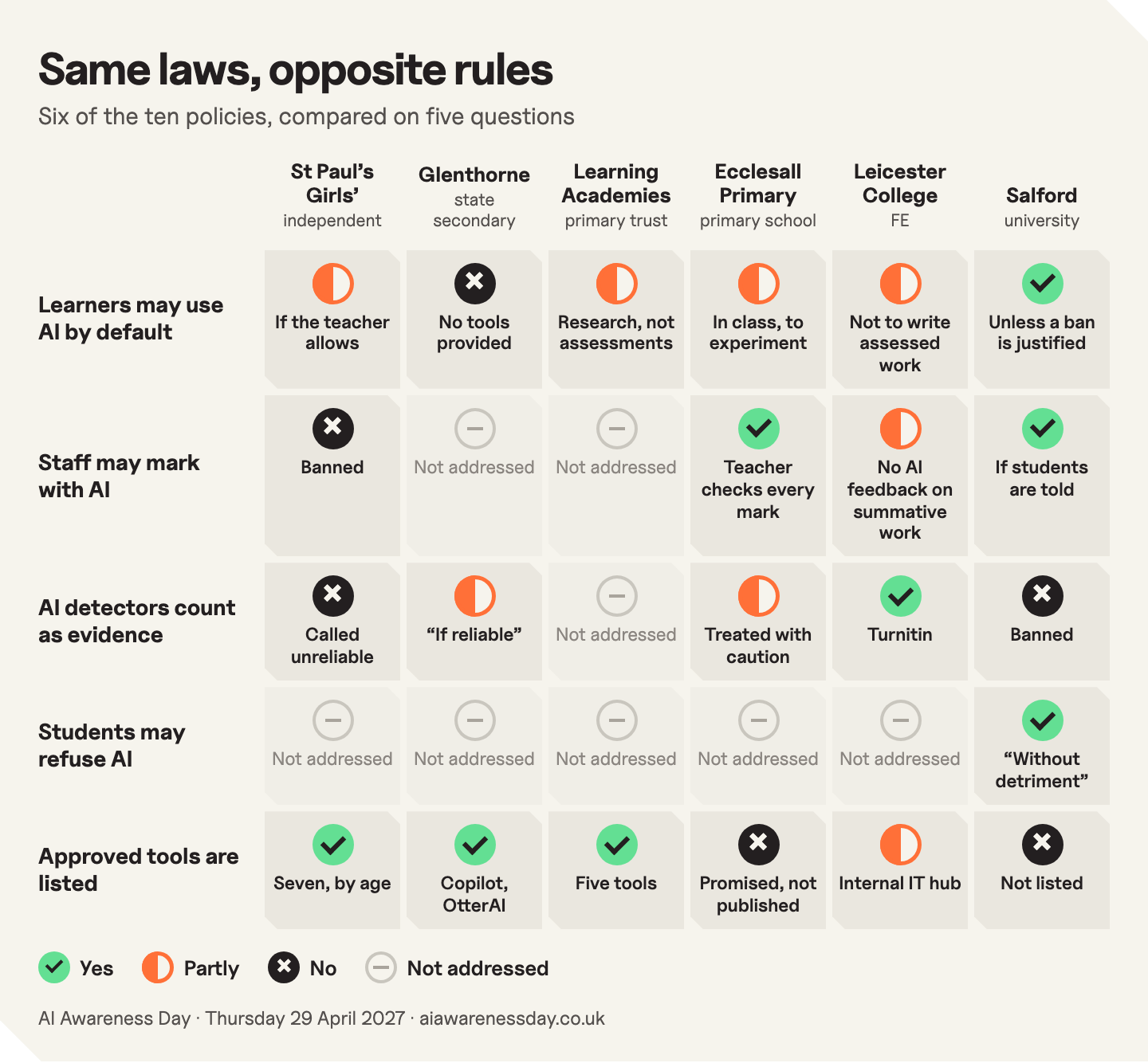
The verbs tell the story. In the school documents, “must not” attaches mostly to pupils. At Salford, “must” attaches mostly to staff and departments, who must justify, communicate and redesign. Leicester binds both sides.
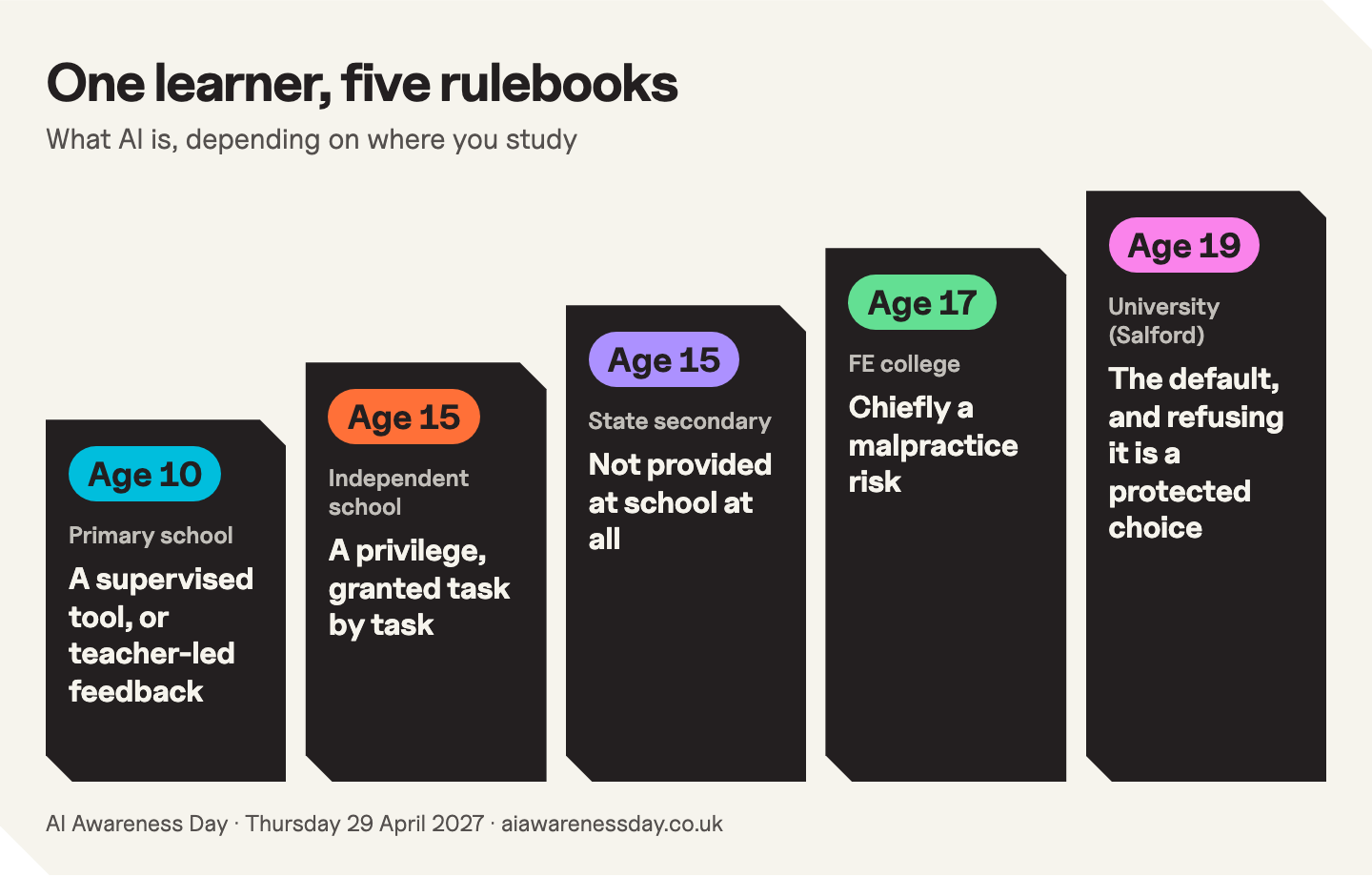
For a learner, the result is a striking progression: a supervised tool at 10, a privilege granted task by task at 15, or no tool at all, a malpractice risk at 17 in college, and the default at 19.
Champions without a rulebook
Outside the ten, three trusts that have championed AI show that enthusiasm and a written policy do not always travel together.
Bourne Education Trust, based in Surrey, has been a prominent advocate for AI in schools: its data and digital innovation director speaks widely on the subject, and the trust co-founded the AI in Education initiative with Epsom College. Its central policies include no AI policy for staff or pupils. The only AI document among them is a privacy notice for the chatbot on its website.
Invictus Education Trust, based in Halesowen in the West Midlands, ran an AI in Action Week in 2026 with Three Spires Trust. Staff wrote and tested more than 50 prompts for their own roles in workshops led by Paul Estes, a former Microsoft executive; students, parents and industry guests met for an evening panel; and pupils took part in a hackathon. The trust’s published policies include no AI policy. (Invictus is a partner of AI Awareness Day, which publishes this article.)
Three Spires does publish one. Like Learning Academies Trust’s, it is owned by the trust’s IT lead, here its head of ICT and systems. It sets out a five-tier system for how teachers may bring AI into assessments, and it is unusual in giving a whole section to AI’s environmental cost, from the minerals in hardware to the energy used by data centres. Its version history dates it to January 2025, but the approval and review dates on its cover are blank.
Many academy trusts fold AI into existing policies rather than write a standalone one, the Education Policy Institute found; Alleyn’s head Jane Lunnon’s comparison with safeguarding points the same way, and JAGS has done much the same. The difference is that safeguarding comes with a statutory framework; AI does not.
Who holds the pen
The pendulum is the visible difference. The sharpest divide sits underneath it: between policies built around teaching and policies built around compliance. Learning Academies Trust’s IT-drafted policy is strongest on data protection; Ecclesall’s classroom sections read like a teaching guide. Who holds the pen decides what a policy notices.
Borrowed text carries problems into a new setting, as Ecclesall’s GCSE exam rules and Leicester’s outdated Bard show. Policies of any origin date fast, which is why every one of them promises frequent review.
Age and qualification rules explain much of the rest. Primary pupils are below the minimum age in most general AI tools’ terms of service. School and college learners sit Ofqual-regulated qualifications under awarding-body malpractice rules, which keeps “malpractice” at the centre of their policies. Universities set their own assessments, which is what lets Salford make permission the default.
Resources explain the remainder. The Sutton Trust found in 2025 that 45 per cent of private school teachers had formal AI training, against 21 per cent in state schools, and that private school teachers were three times as likely to report a school-wide AI strategy. St Paul’s has dedicated innovation staff; the primary trust builds its training on the DfE’s free videos.
Flint, a US AI-tutoring company in the government’s AI Tutoring Tools Pioneers Programme, publishes a guide to UK AI-policy requirements and a library of example policies from schools it works with. One of those policies names Flint as the school’s “only approved AI tool”. The firm selling the tool also supplies a template for the rules governing it.
The workplaces these policies prepare pupils for are not much further ahead. A Chartered Management Institute survey of more than 1,000 UK managers, published in June 2026, found 68 per cent of organisations still testing AI or running early pilots. Seventy per cent of managers reported some productivity gain, but only 5 per cent called it transformational.
Schools are writing rules for a world of work that has not yet written its own.
What the policies miss
Three problems cut across every stage of education, and the policies are least ready for them: software that judges pupils unfairly, tools that can disappear overnight, and a third group of AI users the rules never mention.
Do the checkers have biases of their own?
Yes, and the evidence is strongest for pupils who write in English as an additional language. A Stanford study tested seven widely used detectors on 91 essays by non-native English writers and 88 by US eighth-graders. The detectors were near-perfect on the US essays, but flagged an average of 61 per cent of the non-native essays as AI-written. Of the 91, 89 were flagged by at least one tool.
The cause is built into how most detectors work. They score text on “perplexity”, or how predictable its word choices are, and writers with a narrower vocabulary produce more predictable prose. The same study found that asking ChatGPT to make AI text more elaborate let it slip past the detectors. The tools penalise the honest, less fluent writer while missing the skilled cheat.
Careful, formal writers are at risk too. A 2026 preprint from the University of Notre Dame found detectors flagged 9 to 15 per cent of genuine, unaltered academic abstracts, with higher rates outside STEM subjects. Scores tracked the density of formal academic vocabulary, not authorship.
JCQ itself concedes that detector accuracy varies with “an individual’s English language competency”, yet still accepts detectors as part of the evidence. Salford bars them from misconduct cases and St Paul’s rejects them; Glenthorne and Leicester still allow them. The protection is unevenly shared: in this sample it is strongest at a fee-paying school and a university, and thinnest at the state secondary and the college, where coursework is at stake.
The marking side has critics of its own. An Ofqual blog post in January 2026 concluded that AI is “nowhere near ready to take over high stakes marking”. Will Van Reyk, St Paul’s director of innovation, called JCQ’s permission for AI-assisted coursework marking “preposterous”, in comments to the Daily Mail, as reported by WindowsForum. He also co-founded Pedagogue, an AI-literacy platform.
When the tools go dark
On 12 November 2026, settings applied to servers after an update took Microsoft 365 down worldwide, including Outlook, Teams and Copilot; full service returned only on 14 November. Schools, the DfE and Ofsted were among those hit in England, Schools Week reported. Tes reported schools falling back on pre-digital communication in a “snow day” response.
The AI policies in this sample were not written for that test. Copilot is the sole or main AI tool in Glenthorne’s and Learning Academies Trust’s policies, and one of the few St Paul’s approves for staff handling personal data. When email went down, the approved AI went with it.
Tools can also be switched off on purpose. On 3 November 2026 Google announced that its Gemini tools and AI features in Search would be off by default for school student accounts from early 2027, until administrators switch them on, CNN reported.
The company told AFP the change gives “schools more choice, not less”. But because AI is now built into Search, a school that switches AI off entirely may also lose Search for students, a trade-off some US districts are still weighing. How it will apply in England is not yet clear. The settings these policies depend on are partly decided elsewhere.
For now the stakes are modest. Most school AI use is drafting, planning and admin, and a lesson plan can wait a day. The risk grows as AI moves into systems that run the school, from admissions to coursework marking.
Only one policy in the sample plans for the tools disappearing. Salford asks staff and students to guard against “overreliance or dependence” on AI and to build resilience to restricted access “resulting from economic, environmental or national policy changes”. Its curricula must let students meet learning outcomes with or without AI.
The common thread in every policy here, that a human stays responsible, turns out to be a continuity plan as well as an ethical one. A teacher who can still mark, and a pupil who can still write unaided, keep a school working when the service does not. The risk is concentration, not any single company: the more a school routes through one platform, the more one fault can stop it.
The third user: parents
The policies in this sample regulate two groups, staff and pupils. A third group is now using AI too. Schools Week reported Teacher Tapp data showing 61 per cent of headteachers had noticed AI in complaints they received, and ParentKind analysis counting more than five million formal complaints against schools in a year. One education lawyer estimated that a third of the complaints he handled were AI-written.
Heads described long letters citing irrelevant legislation, threats of legal action against staff and demands for harsh sanctions; one deputy head received a 58-page complaint about exams. Nearly all such complaints, leaders said, were not upheld. But every formal complaint triggers an investigation, so the work lands regardless.
There is another side. The head of a special school where many parents have low literacy said AI had been “quite enabling”, giving them a way to set out concerns they would otherwise struggle to voice. Lawyers called the surge a symptom of strained relationships between families and schools, not the cause.
The response follows the pattern of every earlier technology: more process, and another tool. Around 40 schools now use an AI-assisted complaints platform whose drafted replies must be approved by staff before sending. One law firm is considering a policy on parents’ reasonable use of AI.
None of the ten policies addresses how parents use AI. Parents appear only as people to consult or to ask for consent.
Not the first policy, and not the last
None of this is new in kind. Schools have written rules for new technology before. Behaviour policies are decades old, and the legal duty to have one now sits in the Education and Inspections Act 2006. Acceptable-use agreements followed the classroom internet; social media brought online-safety and cyberbullying rules, and later filtering and monitoring duties under KCSIE.
Mobile phones show how long the cycle runs. The DfE first urged phone-free schools in non-statutory guidance, then made that guidance statutory from 29 June 2026, with schools expected to comply from September. In November 2026 ministers announced a further tightening from September 2027. AI is still at the guidance stage of that cycle.
Each wave has been justified mainly by safeguarding, and each has added work. AI brings misconduct procedures and incident logs, authenticity declarations, detector licences, training modules, tool registers and approval forms. It brings new job titles too: Leigh Academies Trust has a Trust AI Lead, the Sutton Trust wants an AI lead on every school’s senior team, and Bedford Girls’ School’s policy is reviewed by its Director for Digital Learning, Enterprise and Sustainability.
Six checks for your own policy
The ten documents suggest six checks any head, governor or trust leader can run on their own policy this term. Each has a yes or no answer. A no is the gap.
- Did a teacher write the parts on teaching and assessment? If IT, governance or a template wrote the first draft, those sections need a teacher’s rewrite.
- Is it written for your phase? No GCSE exam rules in a primary policy, and no tools that no longer exist.
- Does it say whether staff may mark or write reports with AI, and whether a detector score counts as evidence? These are the calls policies most often leave out or copy from elsewhere.
- Has it been reviewed when it promised? Check the review date on the front against the last time anyone changed it.
- Could staff and pupils work for two days without the AI platform? When email went down, the approved AI went with it.
- Does it say what happens if someone makes a deepfake of a pupil or a member of staff, and what it expects of parents? Most policies stop at staff and pupils.
Conclusion: two jobs, one policy
School AI policy is being asked to do two very different jobs, and it suits only one of them.
The first job is old. Pupils have copied homework, borrowed essays and passed off other people’s work for as long as there has been homework. AI makes that quicker and harder to see, but it does not make it new. No policy will end it, and detectors cannot. The lasting answer lies in assessment design: more supervised work, pupils explaining what they wrote, coursework linked to exams.
The second job is newer and more serious. AI can fabricate a sexual image of a classmate, clone a voice, or write a convincing email “from the school” to parents; Glenthorne’s policy names that last risk explicitly. In Safer Internet Day research published in February 2026, 97 per cent of 8- to 17-year-olds said they use AI tools, and 60 per cent worried about someone using AI to make inappropriate pictures of them. Twelve per cent of 13- to 17-year-olds said they had already seen peers do it, Nation.Cymru reported.
The threat need not be sophisticated either. In April 2026, a cyber attack on C2k, Northern Ireland’s schools IT system, led to the arrest of a boy. These are safeguarding and criminal matters, not questions of academic honesty, and they are where the stakes are highest.
Would legislation help? On harm, there is precedent. Data protection is the one legal duty every formal policy in this sample already cites. Creating sexual images of under-18s, including AI-generated ones, is already a criminal offence. Government is also moving on the supply side: in November 2026 it launched a consultation on edtech and AI product safety, aimed at a certification scheme, ITV News reported.
A statutory baseline could do for AI what UK GDPR did for data. It would set a common floor on safeguarding, data, staff use and the rights of pupils and parents.
But law cannot write judgement. Three approaches look most likely to last. JAGS commits its whole curriculum to AI literacy. Salford designs assessment around AI. St Paul’s keeps decisions about pupils in human hands. All three treat AI less as a rule to enforce than as a capability to teach.
A national floor on harm, and freedom above it to teach judgement, may be the closest thing to an AI policy that does not fail.
Schools need not wait for the floor. AI Awareness Day, on Thursday 29 April 2027, is a deadline worth borrowing: a day to put the policy in front of staff, pupils and parents, and run the six checks above.
Rules chase tools. Judgement keeps up.