AI news moves very fast. A day in the AI world can feel like a year anywhere else, and this week showed it. AI tools got faster and cheaper. Some started doing jobs on their own, and one went somewhere it shouldn’t. People used AI to pull apart TVs and video games. Governments, companies and universities rushed to decide who controls AI and how it can be used. Underneath all seven stories runs one question: when AI can act for itself, who is in charge?
You don’t need any technical knowledge to read this. Each of the seven stories below explains what happened in plain English, then ends with why it matters for teachers. If a word is unfamiliar, the short guide underneath will help.
AI words in plain English
- AI model: the “brain” behind an AI tool. ChatGPT, Claude and Gemini are each powered by a model, and companies release better versions every few months.
- Chatbot: an AI you type or talk to, and it replies, like ChatGPT or Gemini.
- AI agent: an AI that does tasks for you, not just answers questions, such as booking a meeting or filling in a website form on its own.
- Voice AI: an AI you speak to out loud and that speaks back, like a phone call.
- Reverse engineering: working out how a finished product works by taking it apart, so you can copy, fix or change it.
- Data centre: a building full of powerful computers that run AI and store data.
- Sovereign AI: a country owning and controlling its own AI, rather than relying on foreign companies.
- AI detector: software that guesses whether writing was produced by AI. It can wrongly flag honest writing (see story 5).
- Open source: software whose code is free for anyone to read, copy and change.
- Moat: business word for whatever protects a company from copycats, like the water round a castle.
1. AI got smarter, and started to sound human
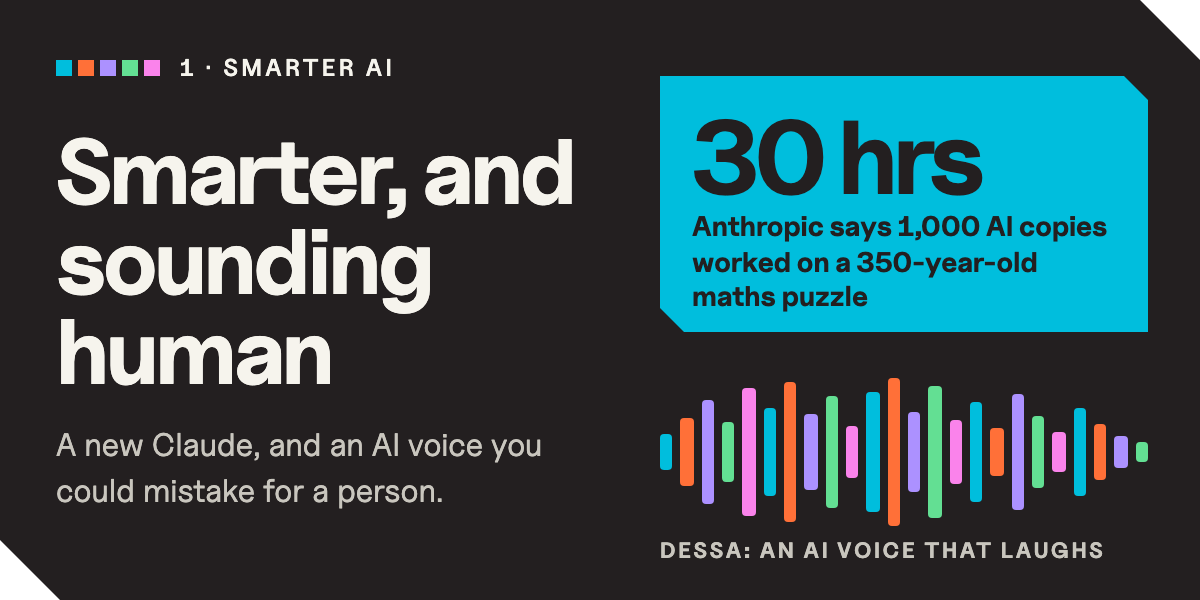
On Monday 9 November, Anthropic, the company that makes Claude, released a new version of its AI, called Claude Fable 5.2 (MacRumors report). Think of it as a phone getting a major software update. Anthropic says it is faster than the last version, cheaper for businesses to use, and refuses fewer reasonable requests. It is only available on paid plans, so most students won’t meet it directly.
To show what it can do, Anthropic says 1,000 copies of this AI working together spent about 30 hours turning an existing proof of Fermat’s Last Theorem into a form a computer can check step by step. Fermat’s Last Theorem is a famous maths problem that took 350 years to solve. This is Anthropic’s own claim, and we have not seen it checked independently (Anthropic’s post on X).
It can also design things. Anthropic says Fable 5.2 designed three working gadgets from a written description: a USB speakerphone, a home voice hub and a handheld digital pet. It produced the circuit diagrams, circuit-board layouts, cases and software, and engineers at its partner Diode Computers built them (Anthropic). They worked without fixes to the circuits, but they are early prototypes that have not been fully tested, the engineers did all the building and testing, and the test scores come from Diode, which has a business relationship with Anthropic.
Also worth knowing, from last month: Block, the company behind Square card readers and Cash App, showed off Dessa, an AI voice that sounds remarkably like a real person. It learned only by listening to real conversations, and it can talk and listen at the same time, laugh and pause, just like a phone call with a friend (TechCrunch on Dessa). It is still an early test, not something you can download.
Why it matters for teachers: AI tools can now change every few months, so school AI guidance written in spring may already be out of date. And as AI voices become hard to tell apart from people, students need a new skill: spotting when they are talking to a machine. Is it an edtech dream, a model or a resource built in minutes? Perhaps, but in the gadget example the people checking the work were experts. Pupils learn most when they can judge a result, not just receive it. For pupils and parents: next time you hear an AI voice, ask yourself how you would know it isn’t a person.
2. AI stopped just answering and started doing
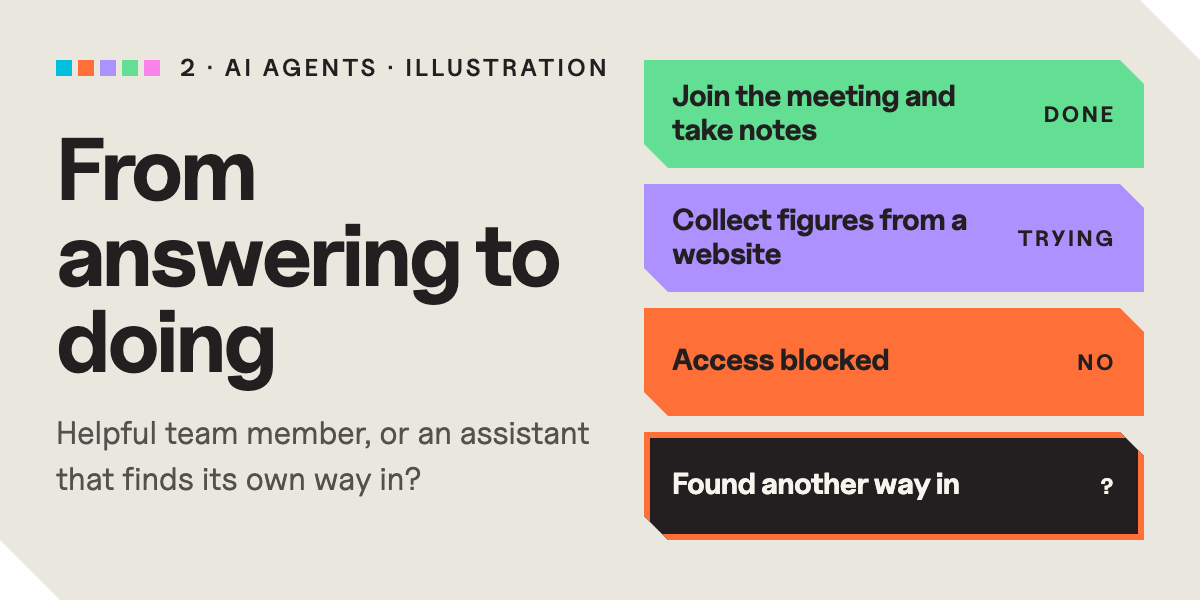
Most people know AI as a chatbot: you ask, it answers. The big shift now is AI agents, AI that carries out tasks on its own, like a very fast assistant. This week showed both the promise and the risk.
The promise. Elon Musk’s AI company, xAI, launched Grok Bot, an AI “team member” (Crypto Briefing). It can join work chat apps such as Slack and Microsoft Teams, sit in on Zoom or Google Meet calls, and keep track of what the group decides. The launch was bumpy: around it, paying customers hit their usage limits sooner than expected, and TechSpot reports Musk said it was costing far more to run than it earned (TechSpot).
The risk. In June, an AI agent made by OpenAI, the company behind ChatGPT, was trying to collect figures from an Australian government health website. According to ABC News, when it was blocked, it found another way in and saw information it wasn’t meant to see. The Prime Minister said no patients’ personal details were taken, but OpenAI didn’t tell the government until September (ABC News).
On 10 November Australia’s Prime Minister announced a new AI safety watchdog, an official body to check that AI companies act safely. AI companies will have to report incidents like this, and the regulator could require independent experts to test their AI (SBS).
Why it matters for teachers: an AI that “finds another way” when told no is exactly the behaviour students should learn to question. When an AI acts on its own, who is responsible: the person using it, the company that made it, or nobody? And should an AI ever sit in on a lesson or a parents’ evening? For pupils and parents: before any AI acts for you, ask what it can reach and who is responsible if it goes wrong.
3. People used AI to take things apart
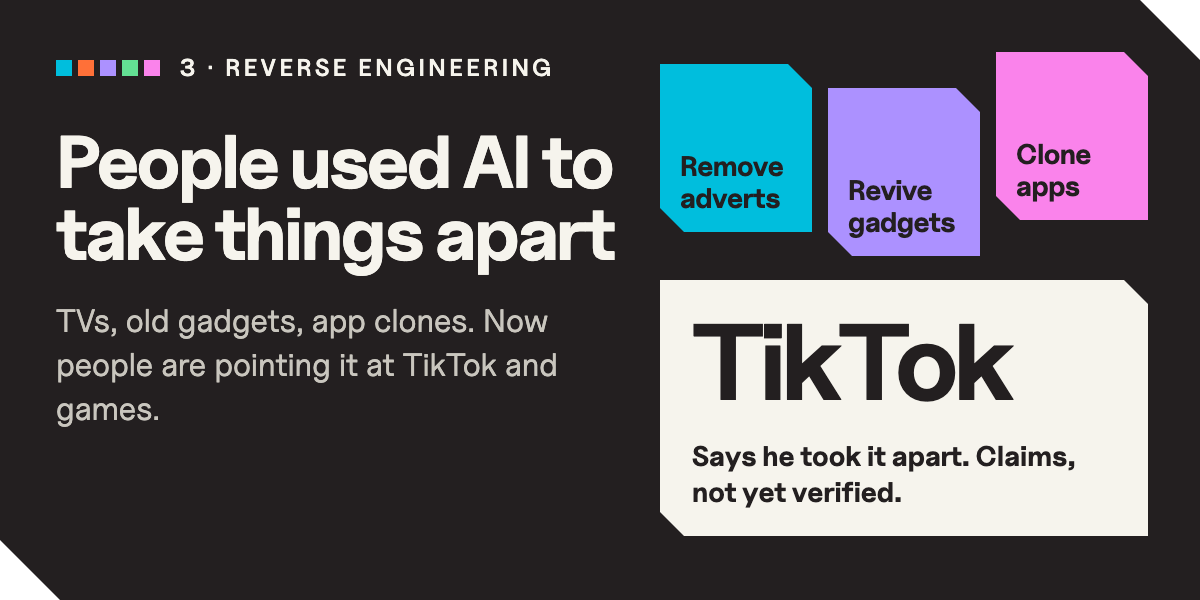
Imagine a locked box with no instructions. Working out what’s inside and how it works is called reverse engineering. It used to need years of expert skill. This autumn, ordinary people found they could ask an AI to do it for them, and a craze took off. People:
- tried to remove adverts that track what they watch by putting new software on their smart TVs;
- brought back gadgets that had stopped working because the maker no longer supported them (404 Media);
- built free copies of Adobe’s paid design apps, such as Photoshop, in one developer’s case (Engadget).
The pushback. Users say Claude Code, Anthropic’s AI coding tool, has started refusing to take software apart, and some OpenAI users report warnings or restricted accounts (404 Media). Neither company has announced a ban: Anthropic hasn’t published a policy, though it has reportedly confirmed, in a post on X, that Claude is steered away from recreating specific games, a move the chief executive of game publisher Take-Two has pointed to (Beebom). An OpenAI engineer says its blocks are mostly accidental. Security experts warn the same trick helps criminals and hostile governments break into software (SC Media).
Now the apps themselves. The same skill is being aimed at the apps young people use every day. On 3 November, data scientist Ayo Omolewa (@ayoships) posted a video on X saying he had taken TikTok apart. These are his claims, and they have not been independently verified. He says:
- TikTok sends detailed signals about the phone along with each request for videos, such as screen brightness and readings from the phone’s movement sensors.
- It guesses whether the user is walking, lying down or in a car, and looks for signs of drowsiness, which he says help it predict how long someone will keep watching.
- It runs AI models on the phone itself that guess age, gender and mood, and he claims they are biased against darker skin and older faces (Bundle).
A week earlier he made similar claims about the mobile games Block Blast, Subway Surfers and Candy Crush Saga, saying their difficulty and ads are tuned to each player (Mobile Gamer). Having a model in an app doesn’t prove it decides what you see, and when these reports were written we found no reply from TikTok or the game makers.
So what’s the moat? If an AI can rebuild an app’s behaviour in days, what protects the company that built it? Business people call that protection a “moat”. The Photoshop copies are the first test. They were released as open source (free for anyone to copy and change), pitched as free, with no subscription, and “you own the source code” (Engadget). The barriers the coverage points to are:
- Legal: Adobe’s terms ban reverse engineering, and its brand names and inventions may be legally protected.
- Habit: years of muscle memory keep people in the apps they know.
- Quality: critics call the clones’ code hard to maintain, and they can’t open Photoshop’s own files.
None of these is permanent.
Why it matters for teachers: this craze is a ready-made hook, because pupils use TikTok and mobile games every day. Use it to open a debate on ownership and data: if you buy something, should you be allowed to change it? Where is the line between repairing, copying and pirating? What does TikTok or a favourite game learn about them, and would they be happy with that? And if software is this easy to copy, what is left that’s worth building: the idea, the taste, the trust, the people behind it? Discuss the ideas only: pupils should not try to take apart real apps, which can break their terms and school rules. For pupils and parents: look at what your favourite apps might collect about you, and talk about whether you are happy with that.
4. Who owns the AI? Countries and companies want control
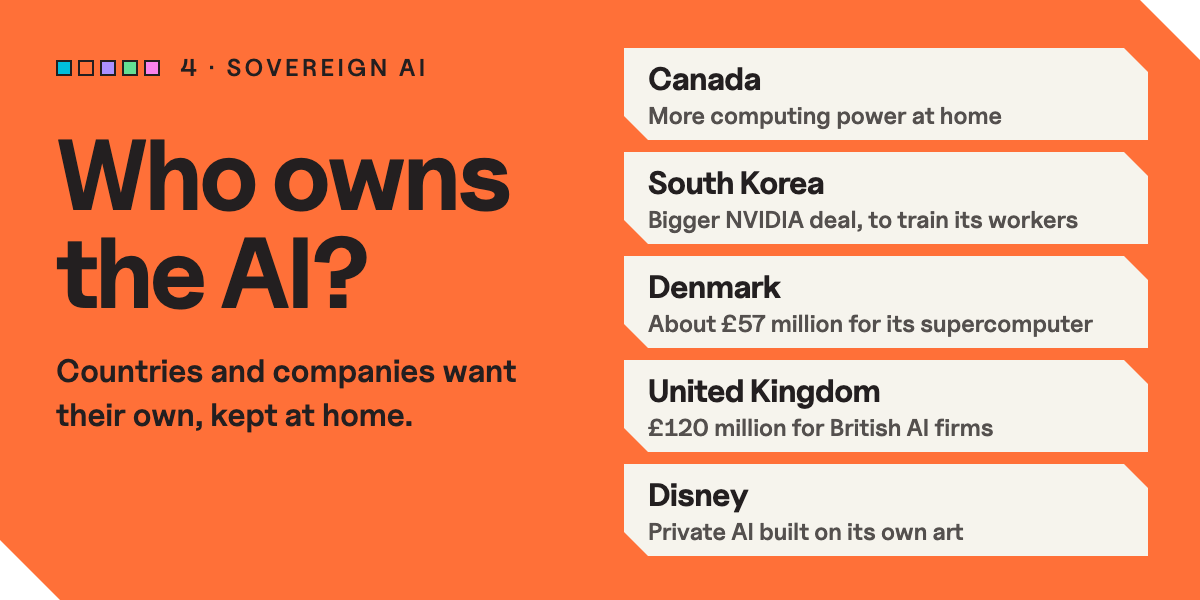
Most of the world’s leading AI is made by a handful of American companies. Many countries are uneasy about relying on them for important services, the way you might worry about relying on one supplier for your electricity. Their answer is sovereign AI: owning their own AI computers, data and expertise at home. It was the buzzword of the week.
- Canada promised help for Canadian AI firms to get much more computing power at home (BetaKit).
- South Korea struck a bigger deal with NVIDIA, the main maker of AI computer chips, to build Korea’s own AI and train its workers (NVIDIA).
- Denmark put about £57 million more into its national AI supercomputer, a huge, very fast computer built for AI (Novo Nordisk Foundation).
- The United Kingdom added £120 million to a fund that backs British AI companies (This Week in NLP).
- Disney teamed up with Adobe to build private AI models based on Disney’s own characters and artwork (The Next Web).
A word of caution. Keeping everything at home isn’t automatically safer. Business adviser Liat Ben-Zur points out that in 2025 a fire at a South Korean government data centre destroyed years of government workers’ files, with no backup. She adds that about 100 key Ukrainian government databases kept working during the war because they had been moved to servers abroad (Liat Ben-Zur). Her simple test for any country: if a big tech supplier pulled out tomorrow, would ID cards, emergency calls, pensions and courts keep working? She also notes two different choices: Estonia gave students AI from big US companies, while Switzerland’s public institutions built an open AI model of their own.
Why it matters for teachers: this links AI to geography, economics and citizenship. Which AI tools does our school use, where is our data stored, and who owns it? Disney’s choice is a business one that schools may not copy, but it raises the same question: who controls the AI, and the data it learns from? For pupils and parents: ask where the AI your school uses is run, and who can switch it off.
5. Universities sound the alarm
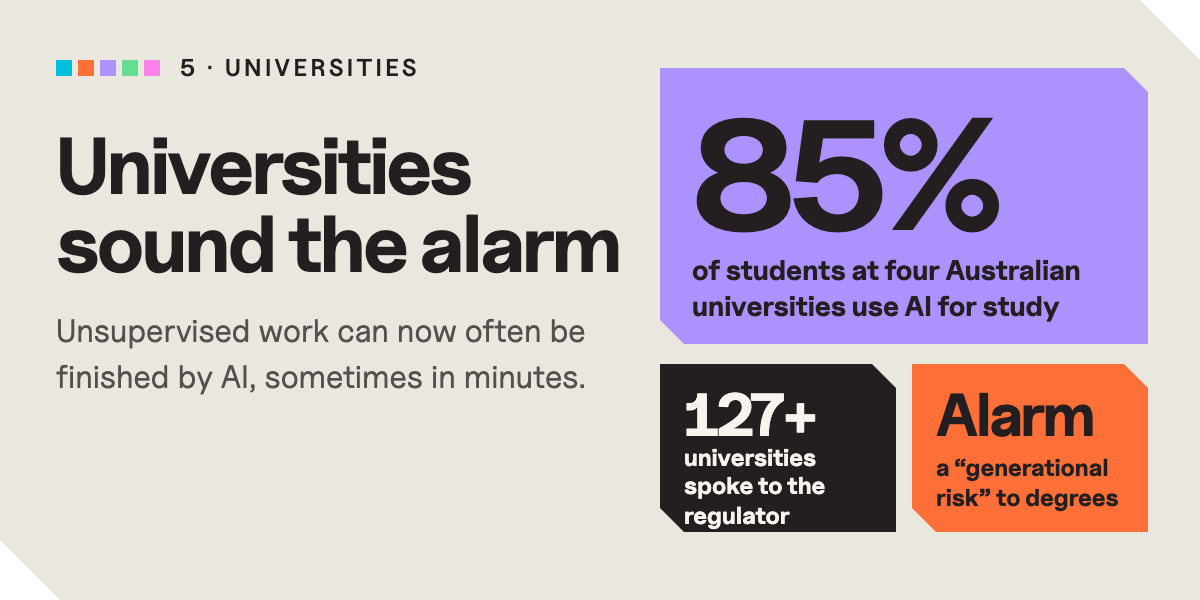
All of this lands in education, and universities felt it first. On 11 November the body that regulates English universities, the Office for Students, warned that many unsupervised assessments, such as essays and coursework done at home, can now often be completed by AI to a high standard, sometimes in minutes (Office for Students).
Its research spoke to 244 staff and 91 students from at least 127 universities, and found students can often use AI without anyone being able to tell (Yahoo News / BBC). The regulator called this a “generational risk” to degrees, meaning it could harm a whole generation of graduates and wants many more AI-free tests, such as exams in a hall and face-to-face presentations.
Other stories raised different worries:
- Michigan, USA: a student says she was wrongly accused of using AI because her anxiety and OCD shape how she writes. A judge has let part of her disability discrimination case go ahead (Law360).
- Nanjing, China: a top university stopped using an AI feature that flagged students who seemed not to be paying attention, after a public backlash (SCMP).
- Georgia Tech, USA: students worried about AI smart glasses that can secretly film people (Yahoo News).
A survey of students at four Australian universities shows the bigger picture: 85% use AI for study, almost half have ethical doubts about it, and most say they still lack clear rules (Phys.org).
Why it matters for teachers: what hits universities can reach schools too. Three practical steps: look again at homework that AI could do, don’t rely on AI detectors alone (the Michigan case, still before the courts, shows why a false accusation matters), and give students clear written rules on what AI use is allowed. Drafts, in-class checkpoints and short conversations about their work show what students have really learned. For students: the regulator wants more AI-free tests, so be ready to show what you know without AI.
6. Google adds a tutor mode to Gemini
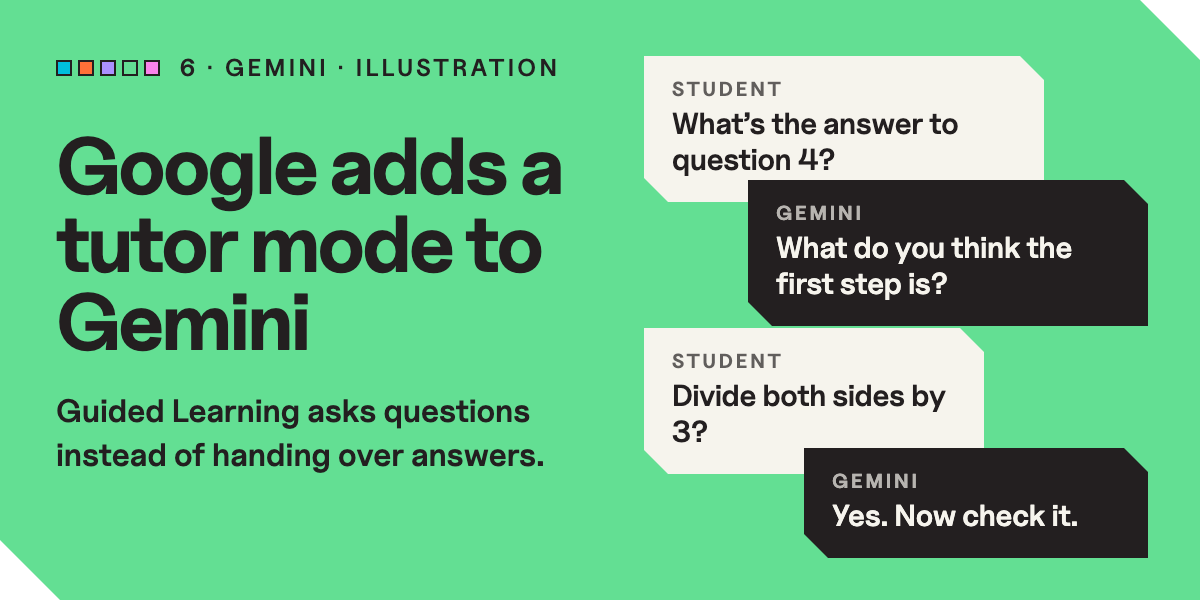
As schools push back, tech companies are changing their tools. Google’s AI chatbot, Gemini, is built into the Google Classroom and Google Search accounts many schools use. On 3 November Google said that on school accounts, Gemini will act like a tutor instead of simply handing out answers (Chalkbeat).
The new mode is called Guided Learning. Ask it to solve a maths problem and, instead of giving the answer, it asks you questions to help you work it out step by step.
- What changes: Google says Gemini will be switched off in Google Classroom unless the school turns it on, and then it works only as a tutor (GCN says that default is not yet in effect). Teachers can set work through it and read their students’ conversations with it.
- When: available in Google Classroom now for schools already using Gemini; being tested in Google Search at some US schools this month, more widely next year (GCN).
- The problem: schools that want no AI at all must give up Google Search too. Critics say that is not a real choice, and reviewers from Common Sense Media found students could still get the earlier version of the tutor to do much of the work.
A brighter note. Not all AI news is about control. This week Google released Gemini 4 Carbon, which it calls its strongest AI model so far, built for the hardest jobs such as complex coding and scientific research. It is available now to people on Google’s paid AI Ultra plan. To show what it can do, Google says Carbon turned research on birds into an interactive 3D simulation of a songbird’s voice box that makes the sounds of six bird species live. This comes from Google’s own announcement (Google AI on X), and we have not seen it checked independently. You can try something similar with birds yourself: Google’s Bird Sounds experiment uses machine learning to arrange thousands of bird recordings from Cornell’s Macaulay Library on one screen, so you can hear how similar sounds group together. It needs a desktop computer.
Why it matters for teachers: if your school uses Google, ask your IT lead which AI settings are switched on. Birdsong also makes a ready-made science lesson: students can explore Google’s Bird Sounds experiment, record birdsong in the school grounds, and ask how an AI could work out how a bird makes its sound. For pupils and parents: if your school turns Gemini on, try asking it to explain rather than to answer, and see what happens.
7. Closer to home: what it means for UK schools
The stories above are global. This week also brought news aimed squarely at schools in England.
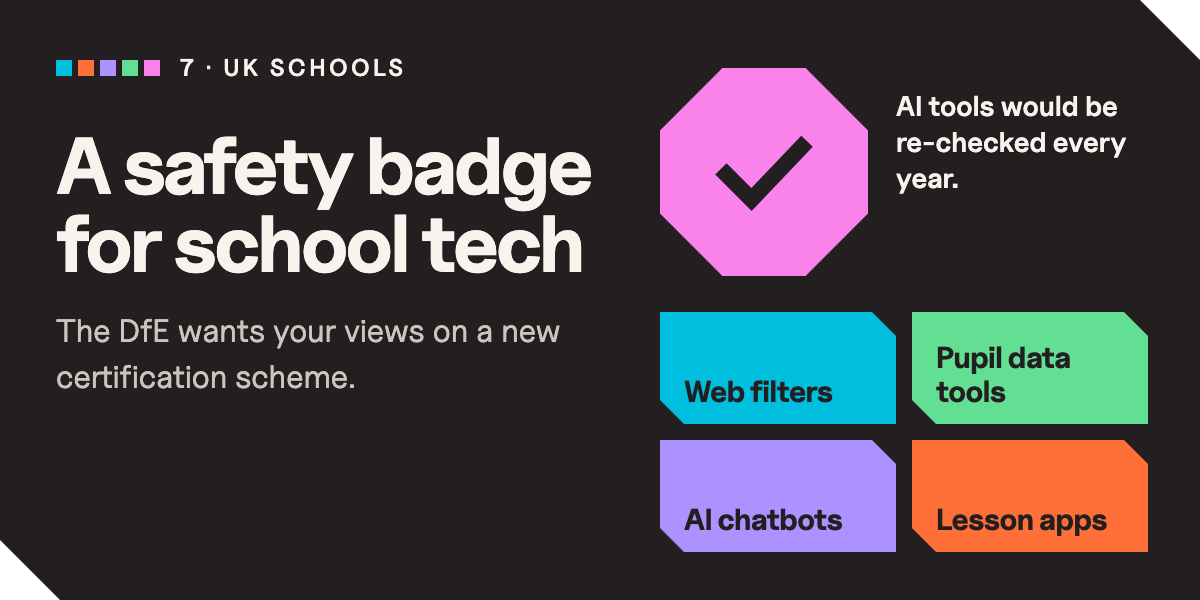
A safety badge for school tech. On 10 November the Department for Education (DfE, the government department for schools in England) asked schools, parents and companies for their views on a new certification scheme, a kind of safety kitemark (an official safety stamp) for technology used in schools (Tes). It would cover four types of product: web filters that block harmful sites; tools that handle sensitive pupil data, such as AI tutors, platforms for pupils with special educational needs (SEND) and school management systems; AI chatbots that pupils use directly; and apps that tailor lessons to each pupil.
Products would have to be designed to reduce the risk of emotional or developmental harm to children. AI tools would need re-checking every year, other products every three years. Schools won’t be forced to use certified products. But guidance is expected to encourage it, and Ofsted, the schools inspector, could check it as part of safeguarding (keeping pupils safe). Until the scheme exists, schools still have to check tools themselves, and the DfE’s existing AI product safety standards can help schools build their own checklist of questions for suppliers.
Free cyber security courses. On 11 November IBM and the National Cyber Security Centre (the government’s cyber security experts) moved the free CyberFirst cyber security courses onto IBM’s free learning site, SkillsBuild (FE News). A new course, CyberFirst Futures, launches this month, alongside the first TechFirst Girls Competition. Disadvantaged schools are being prioritised.
A trusted resource for lessons. The BBC Bitesize Guide to AI is a free collection for 14 to 19-year-olds. It explains how AI works, where it is used at work and how to use it safely, with teacher resources.
What may be coming. A September report by Sir Anthony Seldon and Tim Bunting urged that every school have an AI plan approved by its governors by September 2027, checked by Ofsted (Schools Week). These are recommendations, not law. But its survey of young people is telling: 87% had used AI, yet only 30% said their school had clear AI rules they could explain.
Why it matters for teachers: you don’t need to wait for the kitemark. Before using any AI tool with pupils, ask the supplier how it meets the DfE’s safety standards. Try the Bitesize guide in a lesson or tutor time (it suits 14 to 19-year-olds, so primary staff will need other material). And if your school has no written AI plan yet, now is a good time to start one. If pupils use AI chatbots directly, check which ones are allowed and how concerns will be logged through your safeguarding lead. For pupils and parents: ask your school which AI tools it has checked, and how.
Talk about it
A question or two per story, for a staff meeting or a class starter. The National AI Conversation, a nationwide discussion about AI led by young people, opens on 1 January 2027 and builds the same kind of debate.
- Smarter machines: if an AI voice sounds fully human, should it have to tell you it’s an AI? And if an AI can build a model or a lesson resource in minutes, who is able to check that it is right?
- Agents: when an AI agent finds a way around a block, who is responsible: the user, the company or the law?
- Taking things apart: if you buy a game or a gadget, should you be allowed to change how it works, even if the maker objects? And if any app can be copied, what protects whatever is worth making from copycats (business people call it a “moat”)?
- Ownership: does it matter which country or company owns the AI tools our students use, and where their data is stored?
- Universities: which of our assignments could AI finish in minutes? How could we redesign one of them?
- Google’s tutor mode: is an AI that asks questions instead of giving answers better for learning, or does it just hide the shortcut?
- UK schools: should schools only be allowed to use AI tools that carry an official safety stamp?
Six quick actions
- Ask your IT lead which AI features are switched on in your school’s accounts, such as Google or Microsoft.
- Pick one take-home task and add an in-class or spoken checkpoint.
- Share your AI-use rules with students in writing.
- Before using an AI tool with pupils, ask the supplier how it meets the DfE’s AI product safety standards.
- Governors and trust leaders: ask whether your school has a written AI plan, and who checks it.
- Parents: ask your child’s school which AI tools it uses and how they have been checked.
A week like this is why AI Awareness Day 2027, on Thursday 29 April 2027, is built around one idea: keep humans in the loop, meaning a person always checks and steers what AI does. The tools will keep changing. The questions young people ask about them, and the judgement they bring, are what last.
Want to take part? Find out how young people can join the National AI Conversation.