
The machines are waiting for us. At Anthropic, the company behind the AI assistant Claude, working sessions between staff and the AI spend roughly 80 per cent of their time waiting for a person to respond. For businesses thinking about automating their work, that is a striking sign of how the way work gets done can change. Once software can generate work faster than employees can direct or assess it, the queue forms at the human desk.1
For workers, the implication is less comfortable. Being indispensable to a workflow may confer influence. It also makes a person an obvious target for the next round of process improvement.
Anthropic’s employment report, published on October 16, 2026, describes an organisation that, when hiring, now puts more weight on independence and judgement than on technical know-how. Written by Nathan Wilmers, Regina Catipon, Maxim Massenkoff and Peter McCrory, it draws on internal employment and usage records, output measures, surveys, communications and calendars, supplemented by 17 employee interviews.1
The company presents itself as an early warning of how far AI could change the way work is organised and how many people employers need. It is also a fast-growing maker of the very technology it studies. Its findings invite a question that will increasingly confront employers: how much human involvement produces better outcomes, and how much simply holds up the machinery?
That question reaches beyond software development. It concerns the training of future professionals, the credibility of corporate oversight and the division of economic gains between those who perform work and those who own the systems performing it.
When production outruns approval
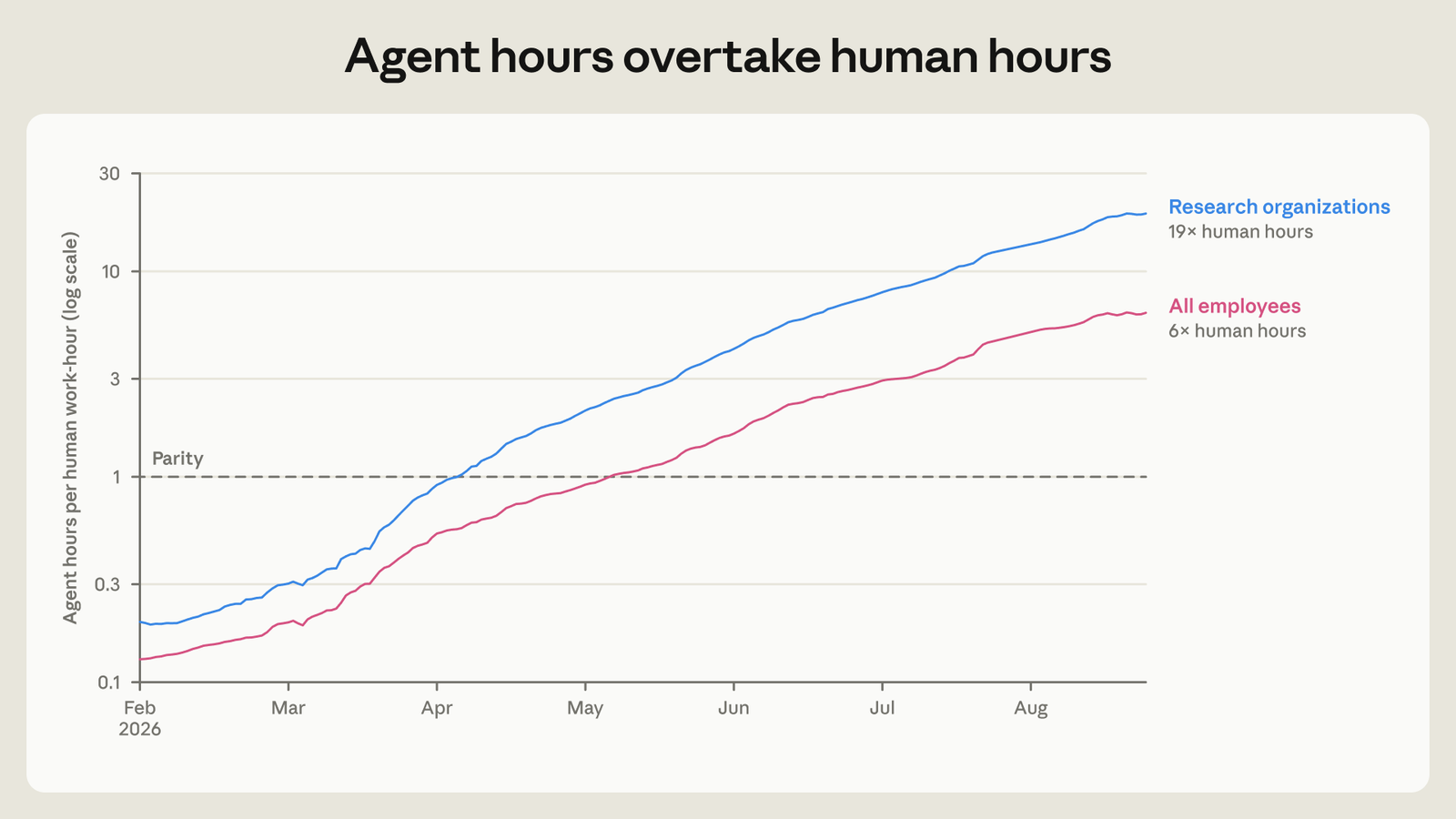
The scale is striking. By August, AI agents (programs that carry out tasks largely on their own) were logging six hours of activity for every hour of estimated human work across Anthropic. Each engineer was saving about five times as many changes to the company’s software, known as code commits, as six months earlier. These measure activity and output, not useful work, and they do not prove a fivefold rise in business value.1
Counting work the agents did on their own as well as work done alongside staff, total agent hours first overtook human hours in March 2026. Agents now help with coding and fixing errors in software, keeping computer systems running, sales paperwork, contracts and scheduling. Their spread beyond engineers is particularly revealing: sessions using AI coding agents among established non-technical employees rose from two per month in August 2025 to 90 in May 2026.1
The gains extend beyond code. The report records increases in contracts processed, invoices handled and deals closed. One salesperson described being able to speak with 30 per cent more customers after automating routine work. Such examples show how an agent can remove administration while leaving a person more time for relationships.1
Anthropic also followed 192 engineers adopting coding agents against 74 who did not adopt during the period studied. Output rose sharply once they started. A separate comparison looked at code written by agents and code written directly by the same person in the same month and part of the codebase; the researchers found no difference in how often it was later deleted or rolled back.1
Those results are evidence against a simple assumption that all the extra output is disposable. They do not establish equal quality in every respect. The study looks at only some measures of quality, such as code deleted when fixing errors, and the engineers chose for themselves whether to use agents. People about to start big projects may have been the most likely to pick up new tools.
A computer can produce more material than anyone has time to read. An organisation benefits only when that material advances something worth doing. Drafts need an audience; software needs to solve a problem; an analysis needs to support a decision. What counts is useful work that is accepted, after allowing for the cost of checking and correcting it.
Consider a team that can now generate 100 proposals in the time it once took to produce five. If a manager can assess only ten, a faster generator will mostly enlarge the backlog. The team needs a way to reject weak proposals cheaply and direct attention towards the few decisions that warrant it.
This is why the 80 per cent waiting figure requires care. Waiting for human input includes more than reviewing finished work. It cannot establish that every pause is wasteful, or that eliminating those pauses would deliver a corresponding gain. A person might be deciding which objective matters, reconciling conflicting instructions or doing other work while several agents run.1
Even so, the incentive is evident. Wherever human attention constrains valuable output, firms have a reason to conserve it. The next competitive advantage may lie in reducing the number of decisions an agent passes up to a person, and giving clearer evidence with those that remain.
A useful system would distinguish an ordinary request from an exception that deserves interruption. It would show what changed, which checks passed and what remains unresolved. Otherwise, the employee who supposedly manages a fleet of assistants risks becoming its shared inbox.
The report estimates that reading all interactive agent output would occupy more than half a working week even in non-technical groups. That is an estimate based on text volume and an assumed reading speed, rather than a record of time actually spent reading. It nonetheless illustrates the attention problem created by cheap generation.1
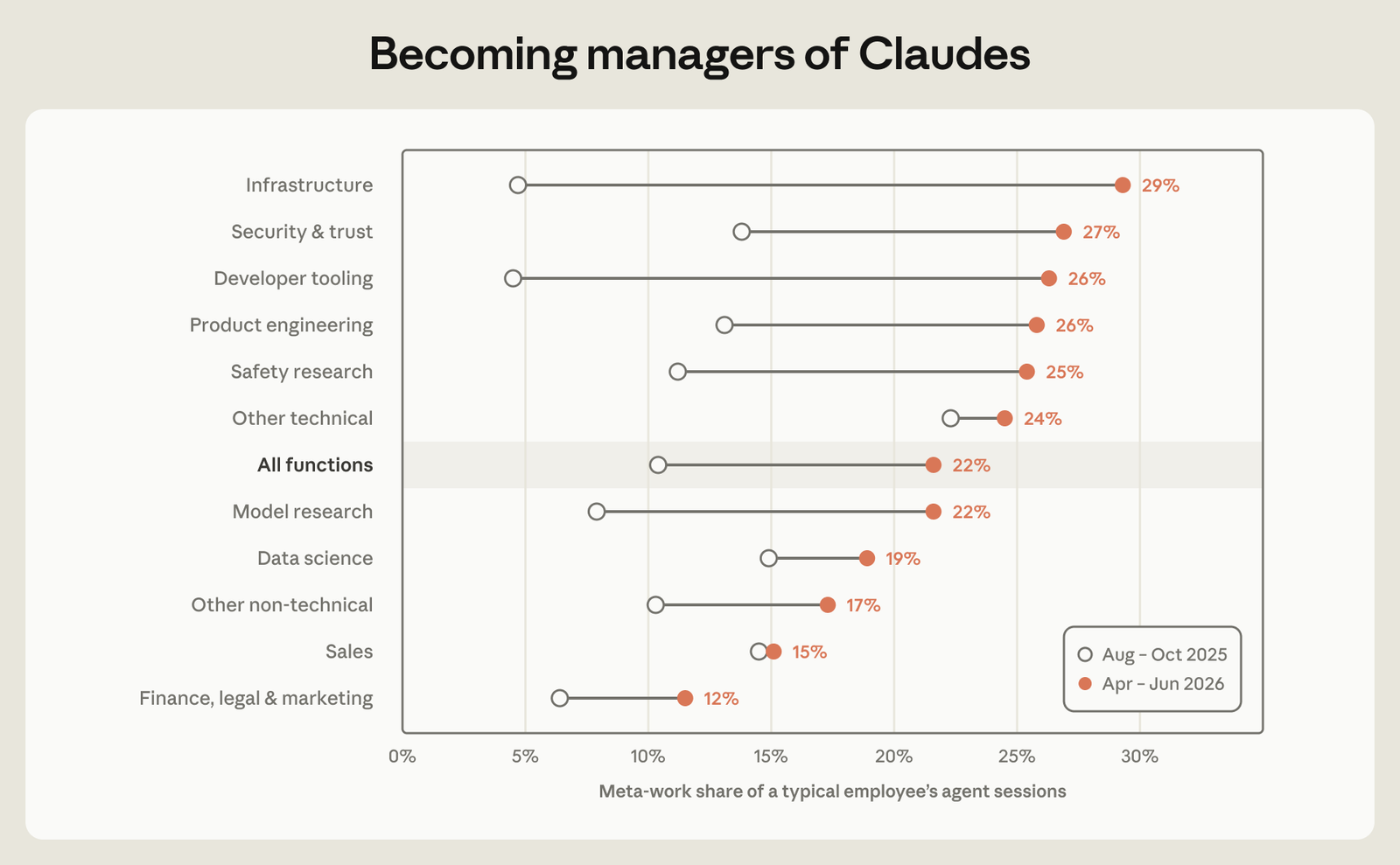
Employees have responded by building systems to organise other systems. Meta-work, meaning work about managing the AI rather than the job itself, such as writing instructions for agents, building dashboards, monitoring automated processes and reviewing what agents produce, rose from 10 per cent of the average employee’s AI sessions in autumn 2025 to 22 per cent in spring 2026. One engineer described facing “an army of Claudes, with every one asking for my attention”. Another likened supervision to babysitting, with trivial requests and serious problems making equally urgent demands.1
Automation has also coincided with more meetings. Median meeting time rose 20 per cent over a year; even engineers and other specialists who manage no one recorded a 16 per cent increase. Company expansion and changing job composition explain part of the increase. The figures still complicate the assumption that extensive automation necessarily produces a quieter working day.1
What human review must earn
Keeping a human in the loop sounds reassuring. Its value depends on whether that person has the time, knowledge and authority to intervene. A signature added to an unread output provides little assurance.
Review has an economic test: the expected harm it prevents must justify the delay and effort it introduces. A routine action that can be reversed, with a reliable automated check, can safely be left largely to the machine. A consequential decision involving uncertain facts or competing interests demands a different standard.
That suggests a gradual move towards supervision by exception: the machines handle ordinary cases within set limits, while people look at failures and at decisions beyond those limits. Spot checks could reveal problems without anyone inspecting every step.
Such an arrangement still needs checks that can spot meaningful errors. Asking a second agent to approve the first agent’s work can reduce some mistakes, but agreement alone offers limited comfort if both rely on the same mistaken assumption. Observable results, independent checks and the ability to reverse an action matter more than a fluent explanation.
There is also work that involves choosing whose interests prevail. A system can calculate the consequences of a decision without possessing a legitimate mandate to make it. Employers will have to tell apart tasks that stay with people because machines cannot yet do them from decisions that stay with people because someone should be answerable for them.
The pressure will not stop at execution. Once a firm has automated drafting or coding, reviewing the resulting work becomes an attractive target. Workers encouraged to specialise in judgement should therefore ask which judgements require their particular knowledge, and which are simply the next tasks waiting to be automated.
The missing first rung
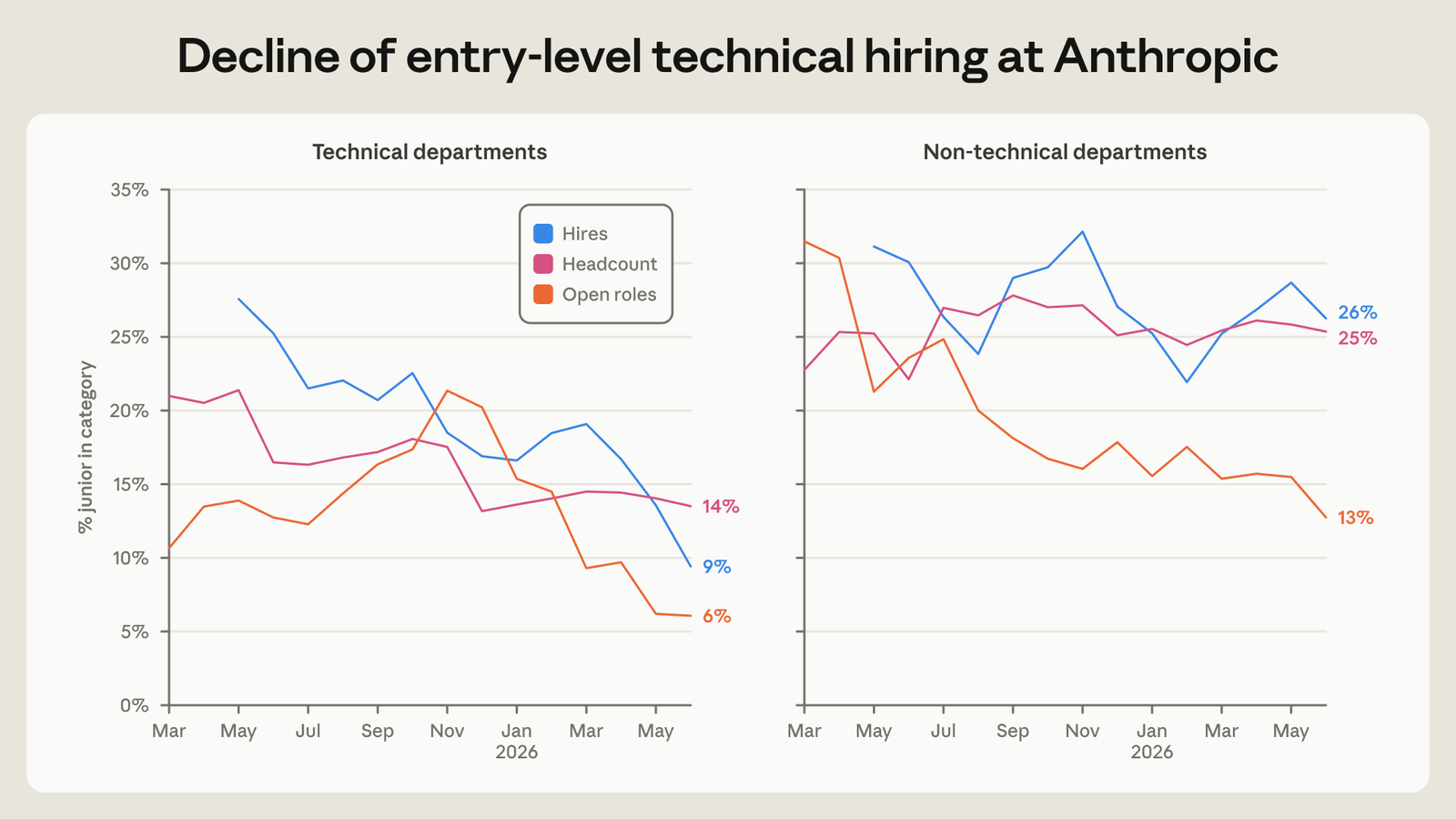
The employment figures give that concern an immediate form. Junior staff’s share of Anthropic’s technical hires fell from 27 per cent to 9 per cent, even as the total number of technical hires kept growing. A falling share should not be confused with a corresponding fall in the number hired.1
Across all technical staff, the junior share fell from 21 per cent to 14 per cent since early 2025. The company says its total workforce tripled over the past year, so a declining proportion cannot by itself establish a decline in junior numbers. Junior job postings fell especially sharply after December 2025. Around one-third of machine-learning managers and one-fifth of software-engineering managers reported hiring less because of AI.1
The composition of the business is changing too. Technical departments fell from 61 per cent to 56 per cent of headcount, as sales, finance and recruiting expanded faster. At a comparable age, Anthropic reports revenue per employee two to four times that of Google and Meta, once adjusted for inflation. This is a comparison of different businesses and periods, rather than an estimate of AI’s isolated contribution.1
For an employer, assigning routine implementation to an agent can be an obvious saving. For a profession, those same assignments can serve another purpose: they give inexperienced people repeated exposure to real problems under supervision.
A beginner learns why apparently sensible code breaks, which assumptions invalidate a forecast and when a problem deserves to be passed up to someone more senior. Experience accumulates through the consequences of decisions, including small mistakes that a senior colleague catches.
If companies retain experienced reviewers while narrowing entry routes, they risk consuming a supply of expertise they are doing less to replenish. A saving on junior recruitment today could become a shortage of experienced talent five or ten years later. That is a risk to the supply of future talent, not a shortage shown by today’s data. The question is how the next generation will acquire judgement when much of the work through which judgement developed has been delegated away.
AI could also provide part of the answer. Juniors might attempt more demanding assignments with automated help, compare alternative solutions and learn through structured review. That would require employers to preserve responsibility and feedback in training. Access to a capable tool, by itself, does not constitute an apprenticeship.
The same distinction applies to the claim that everyone will become a manager of agents. Supervising more output could enlarge an individual’s role while reducing the number of people required for a given volume of business. Whether employment then grows depends on how much additional demand lower costs create.
A company with rapidly expanding sales may redeploy staff and keep hiring. Another facing a fixed market may take the saving as lower payroll costs. Productivity growth leaves room for both outcomes; the experience of a leading AI company cannot tell us how their balance will develop across the economy.
What career advice do we give young people?
The headline unemployment rate is not at crisis levels: the Office for National Statistics put it at 4.9% for April to June 2026.6 But the direction matters. Payrolled employees fell by 101,000 between July 2025 and July 2026,7 and LinkedIn found UK hiring down 24% between January 2019 and January 2026, and 10% year on year.8 LinkedIn put the fall down mainly to economic uncertainty and low business confidence, not to AI.
Entry-level roles are among the hardest hit. A government-published analysis found UK hiring down 14% year on year as of April 2026, with 30 of 38 tracked entry-level occupations declining and software engineer roles down 27%. It noted that employers are favouring experienced candidates who already have the operational skills most newcomers lack.9 The occupations falling fastest are also those where AI has become most visibly capable, but the analysis says further research is needed before conclusions can be drawn about the cause.
Demand is moving, not disappearing. LinkedIn counts 95,000 AI-related roles created in the UK since 2023.8 Young people who build skills in these areas early will be better placed as demand shifts.
So what should we tell a fifteen-year-old? Careers advice built around today’s entry-level job titles risks being out of date before they graduate. The more lasting message is the one employers are already screening for: the ability to decide what should be done, check whether it has been done well, and explain why.
A company reorganising itself
The change is already visible in recruitment assessments. References to candidates’ AI-tool experience tripled for technical roles and quadrupled for non-technical roles between 2024 and 2026. Technical hiring discussions placed increasing weight on autonomy and judgement; a focus on customers and the company’s mission gained prominence for non-technical candidates. Discussion of subject expertise and hands-on technical skills declined in relative importance.1
A preference for people who can move between fields follows from a workplace in which tools keep changing the boundaries of a job. That does not make expertise worthless. People still need enough understanding to frame a useful problem, recognise a questionable result and know when an apparently successful solution has missed the point.
Work is shifting towards strategy, directing agents and the people-centred decisions that hold an organisation together. Interviews, sales calls and negotiations across teams still involve people. The report’s hiring evidence suggests employers increasingly want workers able to decide what should happen and organise the resources to make it happen.
Anthropic is setting up a system to spot roles at risk of disruption and stresses moving people into new jobs inside the company. Employees with at least a year’s tenure were 50 per cent more likely to move between departments in a given month in 2026 than in 2025. Writers on one product design team, after enabling agents to produce its content, moved into writing instructions for the AI and testing how well it performs.1
Back-office teams have stayed relatively small thanks to agents, automated checks and outsourced handling of support requests. Agents also appeared in nearly half of the active public channels on Slack, the workplace messaging app. A detailed example from one department found agents mostly adding to conversations between people rather than replacing them.1
These changes create a further obligation to document decisions. An agent cannot reliably act on a priority agreed in a meeting if the agreement never reaches the information the agent works from. Human coordination therefore creates work of its own: recording decisions, keeping instructions up to date and making clear who is responsible, in a form automated colleagues can follow.
Redeployment offers existing staff a route into new responsibilities. It does less for applicants who never receive an offer. Protecting incumbents and preserving entry routes are separate problems, and an employer can make progress on one while leaving the other unresolved.
A forecast rather than a timetable
A companion Anthropic survey gives the debate a near-term horizon. On average, employees expected AI to be capable of performing 75 per cent of their current work hours by 2030, compared with 28 per cent among employed US respondents. The staff poll drew 1,334 responses and was not adjusted to represent the workforce as a whole.2
The gap extends to scientific capability: 91 per cent of staff expected AI to be able to make a Nobel-level discovery by 2030, compared with 39 per cent of US adults. This measures expectations of discovery capability, not whether an AI system will receive a Nobel Prize.2
Present-day time savings also differed sharply. Asked about a task well suited to today’s AI, 59 per cent of staff said it would take a quarter of the time or less, including checking and fixing the result. Among US adults who use AI at work, the corresponding figure was 26 per cent. These are self-reported assessments for suitable tasks, rather than measured savings across an entire job.2
Those expectations deserve attention because they come from people working closely with the technology. They also come from a particular workplace, with unusual tools, incentives and tasks. They remain beliefs about future capability rather than a measured timetable for replacement.
Automating three-quarters of a job’s current tasks would not automatically eliminate three-quarters of its holders. Remaining tasks might become more valuable, cheaper services might attract more customers, and new responsibilities might emerge. The opposite possibility also deserves a hearing: some employers might be able to meet demand with far fewer people.
For workers planning careers, the difficult issue is the pace of adjustment. Skills can be developed, but meaningful retraining takes time and requires opportunities in which to use it. A forecast of widespread capability by 2030 leaves little room for institutions to assume that change will always arrive slowly.
The profit incentive to automate
In a profit-driven economy, the boundary between human and machine work is subject to continuous commercial pressure. A firm has an incentive to automate when an agent can deliver equally acceptable work at a lower overall cost, or when the extra revenue it enables exceeds the extra cost. No assumption of human obsolescence is required for that calculation.
The comparison runs beyond a subscription price and a salary. Human labour carries benefits, recruitment and training costs. Automated work carries set-up, supervision, correction and upkeep costs, alongside the expected cost of failures and any legal or contractual limits. A task that is technically possible can still cost too much to automate. A rare, unusual case may be too expensive to build in, even when the AI could handle it.
Once that full calculation favours automation, however, there is little commercial reason to exempt a task merely because it is marginal to someone’s job. Employers can remove small portions of work repeatedly. The cumulative effect can be substantial even when no single announcement involves replacing an occupation.
The adjustment can happen through both hiring and the content of existing jobs. Firms may recruit fewer people into automatable roles, leave vacancies unfilled or reduce headcount. They may also retain employees while transferring execution to agents and expanding human responsibility for supervision, strategy and coordination. Slower recruitment can reshape a workforce without a wave of redundancies.
Successful adopters may generate more revenue and profit per employee, increasing the pressure on competitors to follow. Those ratios are not guaranteed to rise: implementation can disappoint, suppliers can absorb the savings and competition can force lower prices. Even an adopter that retains little extra profit may compel rivals to automate simply to remain competitive.
Workers whose expertise makes agents more valuable could command a premium, particularly where they direct complex work, exercise consequential judgement or sustain relationships that customers and colleagues value. Workers whose tasks become readily substitutable face a different bargaining position. Greater individual productivity does not automatically translate into higher pay when an employer can obtain the same output elsewhere more cheaply.
Better AI models can move the line again. Routine, easily checked work is a natural early target. Harder tasks become candidates as reliability improves, it becomes easier to give the AI the background it needs and supervision becomes cheaper. The sequence will vary across businesses: an expensive specialist task may justify investment before a simple but infrequent administrative one. Today’s oversight role should therefore be assessed against a moving frontier.
Employers will also respond differently to displacement. Anthropic’s emphasis on redeployment and employee ownership is one approach. Other firms may choose slower hiring, attrition or redundancies to protect margins. Growth prospects, employment contracts, worker representation and management choices influence which route is available and attractive.
Ownership shapes who benefits from this process. Where ownership of companies is concentrated and workers have limited bargaining power, owners are well placed to capture a disproportionate share of the gains. An IMF working paper published in 2025 models how firms’ incentives to automate costly tasks can amplify adoption and wealth inequality. It also shows why wage inequality and wealth inequality need not move together. These findings come from an economic model, not an estimate of the share of Anthropic’s gains received by shareholders.4
How much of the productivity surplus accrues to capital remains uncertain. Consumers may benefit through lower prices, some workers may secure higher wages, and new demand may create jobs. Owners can take a larger share of the proceeds while wages still rise, if overall output grows enough. The distribution depends on market power, labour bargaining and the institutions governing ownership and transfers.
The pressure to automate is nevertheless persistent wherever expected returns justify it. Without mechanisms that spread ownership or strengthen workers’ claims on the proceeds, a larger capital share and narrower entry routes remain substantial risks. The pace of capability gains determines what can be automated; competition and public choices help determine who benefits.
Who owns the gains
Two days after the employment report, Anthropic announced its Public Benefit Fund. Subject to shareholder approval, the company proposed setting aside 5 per cent of its shares, with the board able to add a further 2 per cent each time the company’s value rises another 50 per cent above a set starting point.3
The fund is to be a company wholly owned by Anthropic, which gives it flexibility over how it gives. Anthropic cited large nonprofit donations and direct distributions to specific populations as possible uses. It said fuller details of governance and the company-value milestones would follow.3
Are the pledges a coincidence
The timing invites an obvious question. Is it a coincidence that AI leaders are promising to share wealth as their own research documents pressure on human employment? In Anthropic’s case, the connection is explicit: its fund announcement identifies possible labour-market instability as a reason more ambitious responses may be needed.3
The discussion extends beyond one company. Associated Press reporting this week describes wealth-sharing proposals from Anthropic and OpenAI, including the latter’s proposed Public Wealth Fund, while noting unresolved questions about beneficiaries, transparency and control. These remain different initiatives with different commitments. They should not be treated as a single industry programme.5
Chronology also matters. Anthropic says its co-founders pledged 80 per cent of their shares when the company was founded, and that its programme matching employees’ donations of company shares also dates from its founding. The latest fund therefore builds on earlier commitments rather than establishing that charitable intentions appeared only when disruption became visible.3
A reasonable inference is that wealth-sharing has become part of how AI companies explain the social consequences of their expected success. A business anticipating concentrated gains alongside displaced incomes has reason to consider how the public will participate. The pledges are consistent with concern about that problem. Public announcements alone cannot establish executives’ private motives or the scale of future displacement.
Such commitments can also serve commercial interests. Giving may strengthen public trust and help sustain acceptance of rapid technological change. Those possible benefits can coexist with sincere philanthropic intentions; the announcement alone cannot establish which motive carries the most weight.
The test will be what the promises deliver. A stake set aside on paper becomes meaningful to affected households through resources actually distributed, understandable eligibility rules and accountable decisions. Who controls the money, how quickly it is deployed and whether recipients have a durable claim on it will matter more than the symbolism of AI bosses promising to give back.
Anthropic’s fund creates scope for an experiment in sharing the proceeds of AI. It does not establish an entitlement for displaced workers, a schedule of payments or a universal basic income. The value of an equity commitment will also depend on the value of the business and the resources ultimately made available for distribution.
Universal basic income (a regular payment to everyone) and the more ambitious idea of a universal high income sit at different points in the debate. Either would require a durable way to distribute purchasing power. A philanthropic fund can contribute resources, but its beneficiaries and decision-making arrangements matter as much as its headline size.
If automation allows a smaller workforce to generate greater value, wages alone may distribute a smaller portion of that value. Letting employees own shares and share in profits can give workers a direct claim on commercial success. Wider ownership of companies, taxes and public payments can spread gains beyond current employees, including people displaced or never hired. Each mechanism raises choices about who qualifies, who decides and who bears losses when expectations disappoint.
Describing workers as future owners is therefore a proposal requiring institutions, rather than an outcome delivered automatically by better software. Owning shares in one employer also exposes a household to the fortunes of that employer. Broader ownership and reliable income support would address different needs.
There is a related limit to celebrating the human bottleneck. Scarcity can strengthen the position of people whose decisions unlock substantial value. Yet if a handful of supervisors can oversee production once requiring hundreds of workers, valuable human judgement can coexist with fewer paid opportunities to exercise it.
Anthropic’s findings offer a view of work in which generating an answer is becoming easier than deciding whether to use it. The immediate task for employers is to make that decision process effective. The larger task is to ensure that people can develop the expertise it requires and share in the value it releases.
As the machinery accelerates, the person checking its work may remain essential. Whether that person has a secure career, meaningful authority and a stake in the proceeds will depend on decisions that companies and governments have yet to make.
A question for the classroom
These are not only questions for big companies. They are already in classrooms. If teachers use AI to create work, mark work and analyse data, and it does some of that better than they can, is that efficiency, or teachers outsourcing their effort to AI?
Teachers are already using it. A YouGov survey of 1,033 UK teachers for Bett, fielded in June 2026, found 52% using AI every week, up from 26% a year earlier. Half of the teachers who use AI (51%) said it had eased their workload, but only 35% were working fewer hours and 55% were working the same. Bett’s explanation was that the time comes back and something else fills it.10
It is the human-review test again. A teacher’s judgement matters most where it cannot be reduced to speed: knowing what a particular pupil needs, spotting a misconception, deciding what a piece of feedback should say. Using AI to draft a worksheet and then checking it is one thing. Handing over the judgement itself is another. The test is whether the teacher can still explain and defend what the AI produced.
Pupils face the mirror image. Ofcom found that 56% of UK 8 to 17 year olds had used AI,11 and Ofqual has told exam boards of its serious concerns about AI-generated coursework, which counts as malpractice if it is submitted as a student’s own.12 In the Bett survey, 57% of secondary teachers had suspected a student of handing in AI-assisted work without permission in the previous four weeks.10 A pupil who pastes in an answer they cannot explain has skipped the part where learning happens. It is the missing first rung, in a classroom.
That is one reason oracy matters. A pupil who can explain their answer aloud has understood it, and asking “how did you get there?” is one of the simplest checks on AI-assisted work there is.
Why we are asking young people to keep humans in the loop
This is why Keep Humans in the Loop is the theme of AI Awareness Day 2027. Anthropic’s findings show how quickly work can be organised around agents, and how much then depends on the people who direct, check and decide. Those people need judgement, and judgement has to be learned.
The young people now at school will be the ones deciding what humans should do and what should be left to machines. We want them to have a say before those decisions are made for them.
From 1 January 2027, the National AI Conversation invites primary, secondary and post-16 students to question, discuss and debate the role AI should play in their lives and futures, building up to AI Awareness Day on Thursday 29 April 2027. Critical thinking, oracy and independent judgement are at its heart.
Sources
1. Nathan Wilmers, Regina Catipon, Maxim Massenkoff and Peter McCrory, How employment is changing at Anthropic, October 16, 2026. https://www.anthropic.com/research/employment-at-anthropic
2. Szymon Sacher, Tess Cotter, Charles I. Jones, Anton Korinek and Peter McCrory, The AI expectations gap, October 16, 2026. https://www.anthropic.com/research/ai-expectations-gap
3. Anthropic, Investing in the public benefit, October 18, 2026. https://www.anthropic.com/news/public-benefit-fund
4. Emma Rockall, Marina M. Tavares and Carlo Pizzinelli, AI Adoption and Inequality, IMF Working Paper WP/25/68, April 2025. The authors’ model distinguishes effects on wages and wealth and incorporates firms’ adoption incentives. DOI: 10.5089/9798229006828.001. https://www.imf.org/-/media/files/publications/wp/2025/english/wpiea2025068-print-pdf.pdf
5. James Pollard and Wyatte Grantham-Philips, Ahead of massive IPOs, AI companies are sketching plans to share their wealth, Associated Press, October 20, 2026. https://apnews.com/article/anthropic-openai-public-benefit-fund-fc16c0ff997c8334dcd71e65d726aadc
6. Office for National Statistics, Labour market overview, UK, August 2026 (unemployment rate of 4.9% for April to June 2026). https://www.ons.gov.uk/employmentandlabourmarket/peopleinwork/employmentandemployeetypes/bulletins/uklabourmarket/august2026
7. Office for National Statistics, Labour market overview, UK, 15 September 2026 (payrolled employees down 101,000 between July 2025 and July 2026). https://www.ons.gov.uk/employmentandlabourmarket/peopleinwork/employmentandemployeetypes/bulletins/uklabourmarket/september2026
8. LinkedIn research on UK hiring, reported by the Press Association, LBC, 9 June 2026. https://www.lbc.co.uk/business/4d91a0d61414448399d88363f13344c5/
9. Department for Science, Innovation and Technology, Entry-level hiring in the UK: a snapshot, 8 June 2026 (brief produced with LinkedIn and the AI & the Future of Work Unit). https://www.gov.uk/government/publications/entry-level-hiring-in-the-uk-a-snapshot
10. Cerys Turner, Teachers’ use of AI soars – but has little impact on working hours, Tes, 27 August 2026, reporting the Bett and YouGov survey Working It Out (1,033 UK teachers, fielded 16 to 29 June 2026). https://www.tes.com/magazine/news/general/teacher-use-ai-soars-little-impact-working-hours
11. Ofcom, Children and parents: media use and attitudes report 2026, published 21 May 2026. https://www.ofcom.org.uk/media-use-and-attitudes/media-habits-children/childrens
12. Ofqual, Senior leadership team briefing pack: AI and coursework integrity, 9 March 2026, on GOV.UK. https://www.gov.uk/government/publications/ai-in-coursework-resources-for-schools/senior-leadership-team-briefing-pack-ai-and-coursework-integrity-accessible